
Buprenorphine and surgery: continue, don’t hold
The recommendation reversed. Why holding buprenorphine before surgery rested on a misreading, and what the receptor kinetics actually show.
Every clinical claim on this page is cited to its source below. How we source clinical content.
The short answer
Continue buprenorphine through surgery rather than holding it. A 2021 multisociety expert panel recommended against routine discontinuation, and a modified-Delphi practice advisory concluded dose reduction is rarely appropriate. Enough mu receptors remain unoccupied for full agonists to work, and stopping carries real risk: opioid-use-disorder recurrence or death (commonly cited at 50–90% after discontinuation), overdose after loss of tolerance, and a difficult reinduction.
For years the standard instruction was to stop buprenorphine before surgery, on the reasoning that its high receptor affinity would block the opioids needed afterward. That reasoning has been substantially overturned, and the current recommendation is close to its opposite.
Key takeaways
- Continue buprenorphine through the perioperative period. A multisociety expert panel in 2021 recommended it should not be routinely discontinued or tapered, and a modified-Delphi practice advisory concluded it is rarely appropriate to reduce the dose.
- The original rationale was a misreading. The practice grew from case reports of undertreated pain, which may have reflected the difficulty of managing opioid-tolerant patients rather than any blocking effect of buprenorphine itself.
- Receptors remain available. A clinically significant proportion of mu receptors are unoccupied even at high stable doses (roughly 9–20% free at 16 mg, 20–35% free at 8 mg), and full agonists can still bind them.1,9
- Stopping carries its own risk — OUD recurrence, overdose after lost tolerance, and a difficult reinduction. In a Medicare cohort with OUD, overdose was about 2.9 times as likely in treatment-gap months.11
- Analgesic ceiling and respiratory ceiling are not the same thing, and neither applies to co-administered full agonists. Conflating them drives poor decisions in both directions.
- Poor initial pain control is not evidence of drug-seeking. It is a predictable feature of an opioid-tolerant patient having surgery.
What the recommendation now says
| Source | Position |
|---|---|
| Multisociety expert panel, 2021 | Buprenorphine should not be routinely discontinued or tapered in the perioperative setting, as adequate analgesia can be achieved1 |
| PAIN clinical practice advisory (modified Delphi) | Continue buprenorphine perioperatively; it is rarely appropriate to reduce the dose, irrespective of indication or formulation. If analgesia is inadequate after optimizing adjuncts, start a full mu agonist while continuing buprenorphine3 |
| ASAM 2020 National Practice Guideline (focused update) | No longer recommends routine perioperative discontinuation; the decision to continue, split, or adjust the dose is left to the care team in coordination with the prescriber2 |
| SAMHSA | Most patients should continue buprenorphine perioperatively because of recurrence risk with discontinuation; SAMHSA updated its guidance to this effect in 20184 |
| APA, OUD treatment in the general hospital | Current practice favors continuing the home dose of buprenorphine perioperatively, with decreased dosing considered in certain circumstances19 |
| Review of hospital OUD care, 2024 | Continue buprenorphine perioperatively without tapering; the harms of discontinuation outweigh any theoretical benefit21 |
| Systematic reviews | No evidence favoring discontinuation, particularly at doses below 16 mg daily. Discontinuation with introduction of a full agonist has been identified as a possible risk factor for OUD exacerbation4 |
A 2025 retrospective cohort in Anesthesiology of 1,881 surgical cases in 1,673 veterans on buprenorphine examined postoperative pain scores and opioid requirements with continuation versus interruption, and supported the guideline direction — continuation was not associated with higher average pain scores or supplemental opioid requirements than in matched controls, whereas interruption was associated with nearly double the supplemental opioid use of continuation (74.2 versus 39.7 mg morphine equivalents per day).5 A recent review characterized the position more bluntly: the data now overwhelmingly refute full preoperative discontinuation.8
This is in the app, with the opioid conversion tools — free tier, no card. Get it →
Where the old practice came from
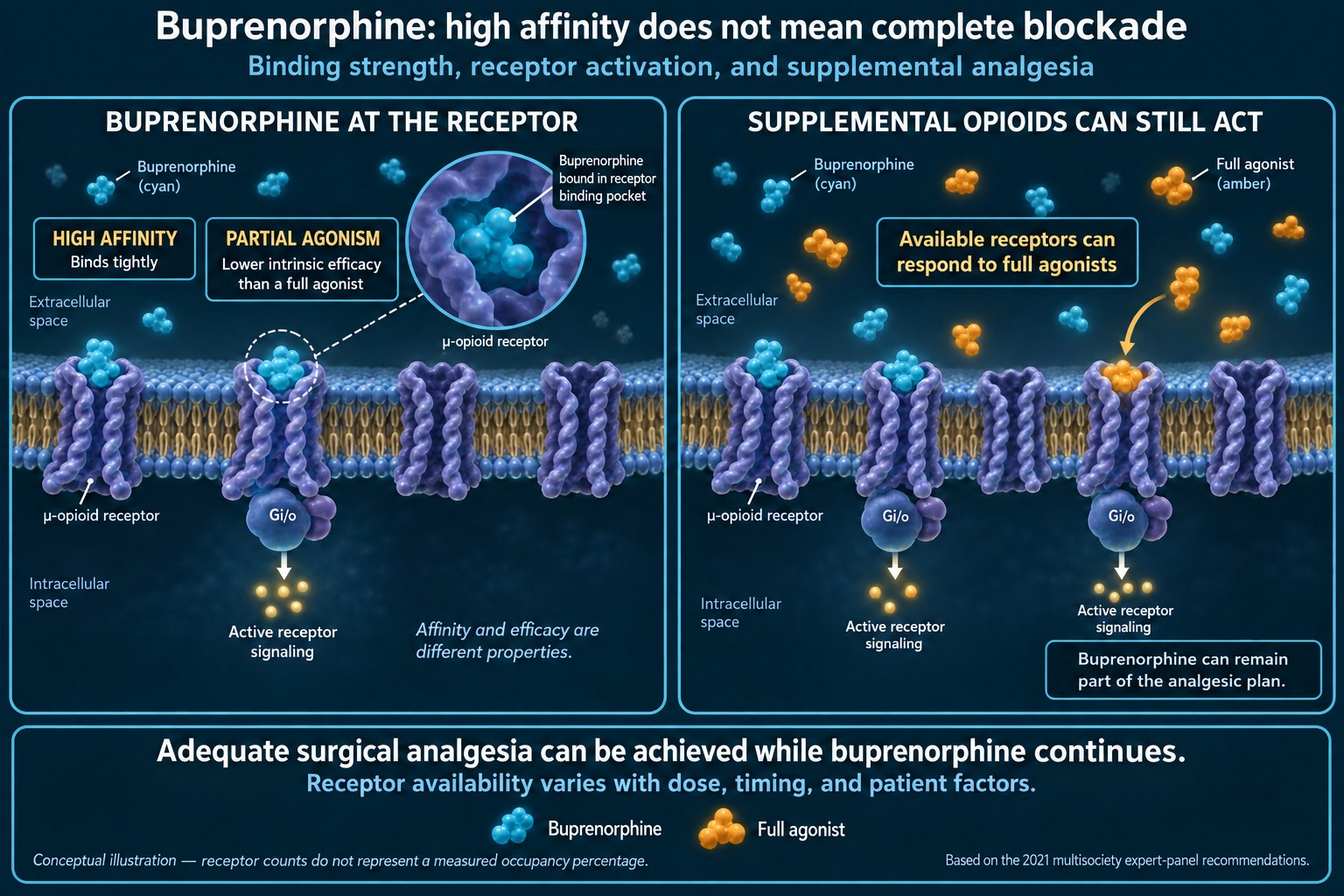
The reasoning was plausible and the evidence behind it was thin. Buprenorphine is a partial mu agonist with very high receptor affinity and slow dissociation, which made it seem obvious that it would displace or block the full agonists needed for postoperative pain. That belief — that adequate pain management was not achievable while a patient remained on buprenorphine — was the stated impetus for perioperative discontinuation.3
But it was built largely on case reports of undertreated pain in this population, which may have reflected the general difficulty of managing opioid-tolerant or opioid-dependent patients rather than an effect of buprenorphine.7 And even at high stable doses, a clinically significant proportion of mu receptors remain unoccupied and available to bind full agonists.12
The kinetics that actually matter
Affinity and efficacy are different properties
Buprenorphine binds the mu receptor with very high affinity — it holds on tightly — but has only partial efficacy, producing a submaximal effect. High affinity is why it is not easily displaced. Partial efficacy is why it has a ceiling. These are separate properties with separate consequences.
The ceiling applies to buprenorphine, not to what you add
This is the distinction most often lost. Buprenorphine’s ceiling on respiratory depression applies to buprenorphine’s own intrinsic effect. It does not extend to co-administered full agonists. A patient on buprenorphine who receives escalating hydromorphone can still develop respiratory depression, and still requires monitoring. The ceiling is pharmacodynamic rather than absolute, and fatal overdose can still occur, particularly with co-ingested CNS depressants.18 The ceiling is not a safety net for other drugs.
Reversal is less straightforward than for a full agonist: the labeling states that higher-than-normal doses and repeated administration of naloxone may be necessary, because of buprenorphine’s long duration of action and its affinity for the mu receptor.16 Titrate to effect and monitor.
Receptor occupancy is not linear with dose
Occupancy is high at typical maintenance doses and falls off substantially at lower doses.1,4 This is the pharmacologic basis for dose-reduction strategies: at 16 mg daily, occupancy is high; reducing toward 8 mg meaningfully increases available receptors.1,4 Protocols that continue buprenorphine at a reduced dose do so to avoid withdrawal while helping full agonists work.12
The figures come from Greenwald and colleagues’ [11C]-carfentanil PET data, reproduced in full by the multisociety panel and by Champagne and colleagues: roughly 20–35% of mu receptors free at 8 mg daily, 13–24% at 12 mg, 9–20% at 16 mg, 4–15% at 24 mg and 2–12% at 32 mg.1,9 The panel notes that the occupancy needed to produce analgesia is unknown, so these are mechanistic figures, not an analgesic threshold.1
Buprenorphine’s analgesia is shorter than its OUD effect
A single dose provides analgesia for roughly 6–8 hours, whereas its suppression of craving and withdrawal lasts around 24 hours. This mismatch is the rationale behind split (three-to-four times daily) dosing to recruit buprenorphine’s own analgesic contribution perioperatively.2,6
The effect at the receptor outlasts the plasma concentration
Buprenorphine’s effect at the receptor, and its analgesic and anti-craving duration, outlast its plasma concentration, because it dissociates slowly from the receptor and clears slowly from the central nervous system. After a single 16 mg sublingual dose, about 70% of receptors remained occupied at 4 hours, 50% at 24 hours and 18% at 76 hours.15 On that basis, holding the drug on the morning of surgery is unlikely to free receptors on the timescale of the operation — an argument that a same-day hold accomplishes little while carrying the full risk of an interrupted treatment. This is mechanistic rationale rather than a directly measured perioperative endpoint.
What to actually do
The default
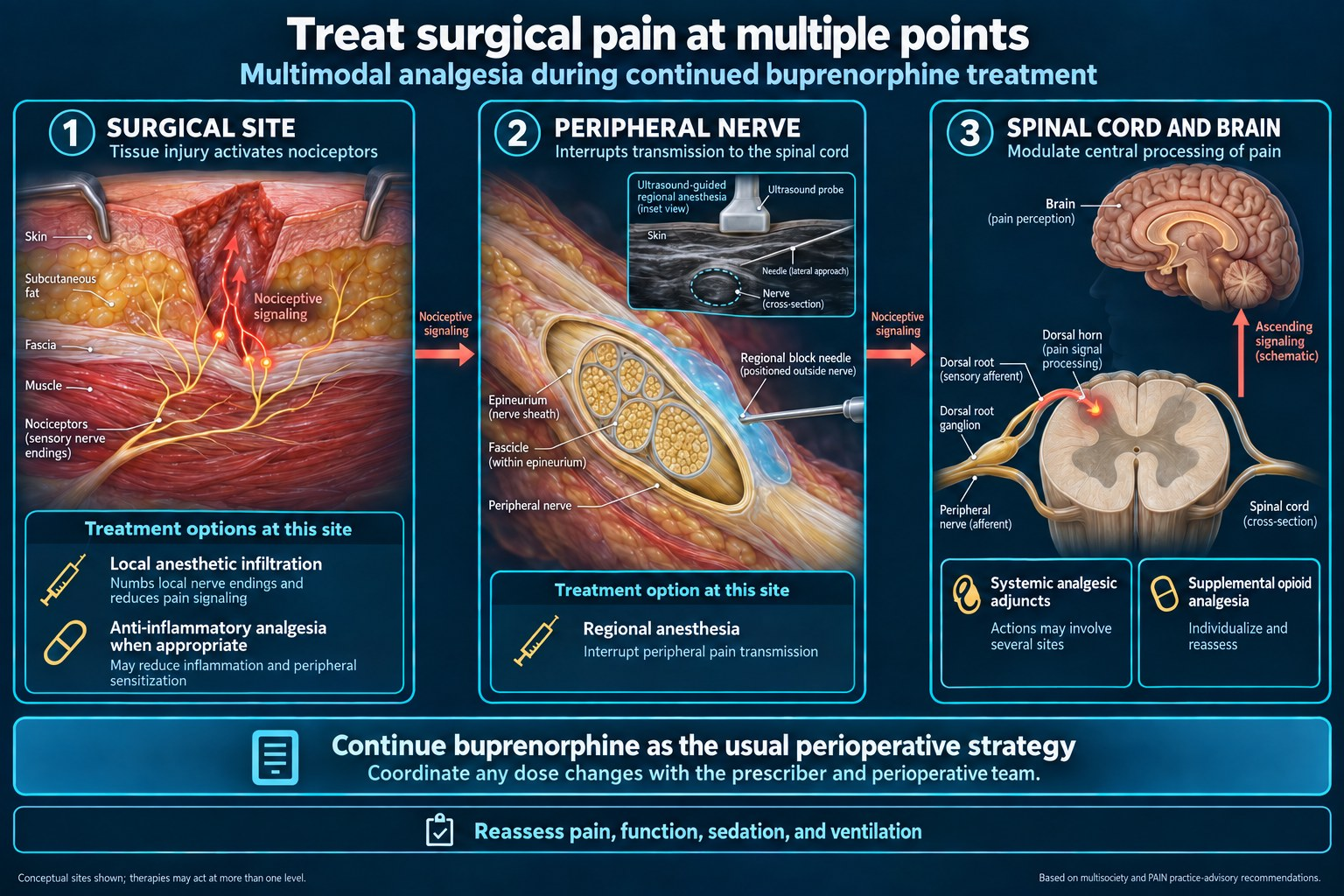
Continue at the usual dose. Plan multimodal analgesia deliberately rather than reactively — regional technique where possible, acetaminophen, NSAIDs where not contraindicated, ketamine and intravenous lidocaine intraoperatively where appropriate, and gabapentinoids where suitable.13
Where a modification is considered
Where the dose exceeds 16 mg daily and moderate-to-severe pain is expected, some institutions split the dose to maximize buprenorphine’s own analgesic contribution.10 One published schedule, from Quaye and Zhang, reduces the dose to 16 mg the day before and 8 mg on the day of surgery and through the postoperative period, to increase receptor availability for full agonists.8 ASAM describes temporarily increasing the dose or dosing frequency instead;2 the APA resource document divides the daily dose into 8-hour intervals,19 and ACOG into three-to-four doses every 6–8 hours.17 Others recommend continuing without any reduction,4 and the newer position of the multisociety panel and recent reviews is that tapering should be avoided to preserve stability.1,6 The practice advisory position is that reduction is rarely appropriate.3
What is consistent across sources is that this should be a planned decision made with the buprenorphine prescriber, not a default applied at the pre-op desk.13
If analgesia is inadequate
Optimize the adjuncts first, then add a full mu agonist while continuing buprenorphine — not by stopping it.3 Prefer high-affinity full agonists such as fentanyl or hydromorphone for breakthrough pain, and note that supplemental buprenorphine dosing itself can be analgesic.1 Expect to need higher full-agonist doses than in an opioid-naive patient, and monitor accordingly.
A point worth stating plainly. Poor initial response to opioid analgesia in a patient on buprenorphine is a predictable pharmacologic finding, not evidence of drug-seeking. Interpreting it that way is a documented failure mode in this population, with consequences for both the pain and the therapeutic relationship.
Discharge and reinduction
Patients should ideally be discharged on buprenorphine, though not necessarily at the preoperative dose; depending on analgesic requirement, discharge on a full agonist may be appropriate.3 Where the drug was held or tapered, reinitiation should be arranged before discharge or as soon as feasible — and that coordination should be scheduled before the surgery rather than left to the patient to manage.10 Low-dose induction allows reinitiation without requiring the patient to experience withdrawal.10 Provide take-home naloxone and overdose-safety counseling at discharge, particularly if the dose was reduced or held or if a full agonist is co-prescribed.2,19
Two distinctions to establish preoperatively
- Why is the patient on buprenorphine? The practice advisory specifies distinguishing chronic pain use from opioid use disorder, because long-term treatment retention and harm reduction dominate the calculus when OUD is the primary diagnosis.3
- Which formulation? Sublingual and injectable preparations are approved for OUD; buccal and transdermal are approved for chronic pain.4 For the sublingual buprenorphine/naloxone combination, naloxone’s bioavailability by this route is negligible and it does not affect buprenorphine’s pharmacokinetics,16,20 and the presence or absence of naloxone does not prohibit continuing buprenorphine perioperatively.9 Extended-release injectable formulations cannot be held in any meaningful sense — the decision is already made by the time the patient arrives — and there is essentially no perioperative or acute-pain research specific to the long-acting injectables.9
Special populations
- Peripartum patients. Treatment interruption carries heightened recurrence risk with consequences for both mother and child; continuation is generally favored, in coordination with the obstetric and addiction teams.8 ACOG recommends continuing the maintenance dose through labor and the postpartum stay with additional analgesia, and notes that patients on buprenorphine needed about 47% more opioid after cesarean delivery.17
A phased approach
Management can be organized into three phases — preoperative (confirm indication, formulation, dose, and prescriber; plan whether to continue or split), day-of / acute pain (continue buprenorphine, layer multimodal adjuncts, add a high-affinity full agonist while monitoring for respiratory depression), and discharge (resume or reinduct buprenorphine, arrange prescriber follow-up, dispense naloxone). For hospitalized patients with OUD more broadly, Englander and colleagues frame care as three stages: stabilize, continue OUD treatment, and anticipate and support the transition out of hospital.21
Frequently asked questions
Do I have to stop Suboxone before surgery?
Current guidance says no. A multisociety expert panel in 2021 recommended that buprenorphine should not be routinely discontinued perioperatively,1 and a modified-Delphi practice advisory concluded that it is rarely appropriate to reduce the dose at all.3 The ASAM 2020 focused update no longer recommends routine discontinuation.2
Will buprenorphine block my pain medication after surgery?
Not completely. A clinically significant proportion of mu opioid receptors remain unoccupied even at high stable buprenorphine doses, and full agonist opioids can still bind them.12 Higher doses of full agonist may be required than in an opioid-naive patient, but adequate analgesia is achievable while buprenorphine is maintained.3,8,14
Why did the advice change?
The original practice grew out of case reports of undertreated pain, which may have reflected the general difficulty of managing opioid-tolerant patients rather than a blocking effect of buprenorphine itself.7 Once studies looked directly, maintaining buprenorphine was not associated with worse pain control, and the risks of stopping — recurrence, overdose, difficult reinduction — became clearer.4,8,14
What if the dose is 16 mg or higher?
Practice varies. Some institutions split the dose and reduce it toward the day of surgery when moderate-to-severe pain is expected, for example to 16 mg the day before and 8 mg on the day.8,10 ASAM describes increasing and dividing the daily dose for analgesia.2 Others continue without reduction, and the multisociety panel advises against tapering.1,4 The Delphi practice advisory holds that reduction is rarely appropriate.3 This should be decided in advance with the prescriber.
Does buprenorphine’s ceiling effect make added opioids safe?
No, and this is a common and dangerous misreading. The ceiling applies to buprenorphine’s own intrinsic effect, not to co-administered full agonists. A patient receiving escalating full-agonist opioid alongside buprenorphine can still develop respiratory depression and requires monitoring.
What happens if buprenorphine is stopped for surgery?
Patients who discontinued buprenorphine maintenance had a greater than 50% chance (range 50–90%) of OUD recurrence or death, in data from Bentzley and colleagues cited by the multisociety panel.1,9 Stopping also risks overdose from lost tolerance and a difficult transition back. In a Medicare cohort with OUD, overdose was 2.89 times as likely in treatment-gap months as in treated months (a gap being 15 or more consecutive days without buprenorphine).11 That is an outpatient association rather than a perioperative study, so applying it to a planned, monitored hold is an extrapolation. If it is held, reinitiation should be arranged before discharge and scheduled before the surgery rather than left to the patient.10
References
- Kohan L, Potru S, Barreveld AM, et al. Buprenorphine management in the perioperative period: educational review and recommendations from a multisociety expert panel. Reg Anesth Pain Med. 2021;46(10):840–859. doi:10.1136/rapm-2021-103007. PMID 34385292.
- American Society of Addiction Medicine. The ASAM National Practice Guideline for the Treatment of Opioid Use Disorder: 2020 focused update. J Addict Med. 2020;14(2S Suppl 1):1–91. doi:10.1097/ADM.0000000000000633. PMID 32511106. Discontinuation before surgery is not required; dose decisions are individualized with the addiction treatment provider, and temporarily increasing the dose or dosing frequency (split dosing) may help manage pain.
- Goel A, Azargive S, Weissman JS, et al. Perioperative Pain and Addiction Interdisciplinary Network (PAIN) clinical practice advisory for perioperative management of buprenorphine: results of a modified Delphi process. Br J Anaesth. 2019;123(2):e333–e342. PMC6676043.
- Selvamani BJ, Kral L, Swaran Singh T. Perioperative management of patients on buprenorphine for opioid use disorder. ASRA News. February 2023;48(1). doi:10.52211/asra020123.010. Summarizes the 2021 multisociety panel, the 2018 SAMHSA update, and systematic reviews finding no evidence favoring discontinuation, especially below 16 mg daily.
- Hitt JM, Elkin PL, de Leon-Casasola OA. Continuation versus interruption of buprenorphine/naloxone in adult veterans undergoing surgery: examination of postoperative pain and opioid utilization in a national retrospective cohort study. Anesthesiology. 2025;142(2):320–331. doi:10.1097/ALN.0000000000005291. PMID 39527644. PMC11732713. Retrospective cohort, 1,881 surgical cases in 1,673 patients. Supplemental opioid 74.2 mg morphine equivalents per day with interruption versus 39.7 with continuation.
- Harin E, Ashok V, Andereggen L, Urman RD, Luedi MM. An individualized, interdisciplinary approach to the perioperative care of patients on buprenorphine. Curr Pain Headache Rep. 2026. doi:10.1007/s11916-026-01545-w. PMID 42581132. PMC13461782.
- Desai A, Parikh S, Bergese S. Perioperative buprenorphine management and postoperative pain outcomes: a retrospective study with evidence-based recommendations. Int J Transl Med. 2024;4(3):539–546. doi:10.3390/ijtm4030036. Describes the origin of the discontinuation practice in case reports of undertreated pain.
- Vadivelu N, Mydlo N, Dextras C, et al. Perioperative management of patients on buprenorphine. Curr Pain Headache Rep. 2026. doi:10.1007/s11916-025-01432-w
- Champagne K, Date P, Forero JP, Arany J, Gritsenko K. Patients on buprenorphine formulations undergoing surgery. Curr Pain Headache Rep. 2022;26(6):459–468. doi:10.1007/s11916-022-01046-6. PMID 35460492.
- Wyse JJ, et al. Perioperative management of buprenorphine/naloxone in a large, national health care system: a retrospective cohort study. J Gen Intern Med. 2021. doi:10.1007/s11606-021-07118-4. Describes dose-splitting above 16 mg, care coordination for reinitiation, and low-dose induction.
- Gibbons JB, McCullough JS, Zivin K, Brown ZY, Norton EC. Association between buprenorphine treatment gaps, opioid overdose, and health care spending in US Medicare beneficiaries with opioid use disorder. JAMA Psychiatry. 2022;79(12):1173–1179. doi:10.1001/jamapsychiatry.2022.3118. PMC9535497. Opioid overdose was 2.89 times as likely in treatment-gap months as in treated months.
- Perioperative pain management guidance for patients on chronic buprenorphine. US Department of Veterans Affairs, February 2022. va.gov/formularyadvisor/DOC_PDF/CRE_Buprenorphine_Perioperative_Guidance_FEB2022.pdf. Notes that a clinically significant proportion of receptors remain available even at high stable doses, and that this finding drove the change in expert consensus.
- Guidelines for the perioperative management of buprenorphine. US Department of Veterans Affairs, February 2022. va.gov/formularyadvisor/DOC_PDF/CRE_Periop_BUPRENORPHINE_Algorithm_FEB2022.pdf. Multimodal strategy including regional catheters, ketamine, lidocaine, gabapentinoids, acetaminophen and NSAIDs.
- Quaye A, Potter K, Roth S, Acampora G, Mao J, Zhang Y. Perioperative continuation of buprenorphine at low-moderate doses was associated with lower postoperative pain scores and decreased outpatient opioid dispensing compared with buprenorphine discontinuation. Pain Med. 2020;21(9):1955–1960. doi:10.1093/pm/pnaa020. PMID 32167541. Retrospective single-center comparison of 55 surgical patients, 38 continued against 17 held: PACU pain scores 2.9 versus 7.6, and mean morphine equivalents dispensed 229 versus 521.
- Davis MP, Pasternak G, Behm B. Treating chronic pain: an overview of clinical studies centered on the buprenorphine option. Drugs. 2018;78(12):1211–1228. doi:10.1007/s40265-018-0953-z. CNS clearance slower than plasma clearance; receptor occupancy after a single 16 mg sublingual dose.
- Suboxone (buprenorphine and naloxone) sublingual film. Prescribing information. DailyMed, US National Library of Medicine; updated December 2025. dailymed.nlm.nih.gov/dailymed/drugInfo.cfm?setid=8a5edcf9-828c-4f97-b671-268ab13a8ecd. Higher-than-normal doses and repeated administration of naloxone may be necessary.
- American College of Obstetricians and Gynecologists, Committee on Obstetric Practice. Committee Opinion No. 711: opioid use and opioid use disorder in pregnancy. Obstet Gynecol. 2017;130(2):e81–e94. doi:10.1097/AOG.0000000000002235.
- Kozińska RB, Ślęzak J, Ilski I, et al. Can buprenorphine be overdosed? The ceiling effect and its clinical implications. Pharmaceuticals (Basel). 2026;19(6):903. doi:10.3390/ph19060903. PMID 42356521.
- Funk MC, Nash S, Smith A, et al. Treatment of opioid use disorder in the general hospital. Am J Psychiatry. 2023;180(8):594–596. doi:10.1176/appi.ajp.23180008. American Psychiatric Association resource document, approved 2022.
- Saari TI, Strang J, Dale O. Clinical pharmacokinetics and pharmacodynamics of naloxone. Clin Pharmacokinet. 2024;63(4):397–422. doi:10.1007/s40262-024-01355-6.
- Englander H, Thakrar AP, Bagley SM, et al. Caring for hospitalized adults with opioid use disorder in the era of fentanyl: a review. JAMA Intern Med. 2024;184(6):691–701. doi:10.1001/jamainternmed.2023.7282.
Further reading
- Anderson TA, Quaye ANA, Ward EN, Wilens TE, Hilliard PE, Brummett CM. To stop or not, that is the question: acute pain management for the patient on chronic buprenorphine.Anesthesiology. 2017;126(6):1180–1186.
Disclaimer. Reference information for licensed clinicians and students. Not a medical device, and not a substitute for clinical judgment. Decisions about buprenorphine should involve the prescriber. Verify against your institutional protocol and current package inserts.
Perioperative medication decisions like this one ship inside Helix Anesthesia — a point-of-care reference built by a practicing CRNA, with drug entries, hold and restart intervals, and surgical cases, all cited and available offline. See how we source clinical content.
Built for the anesthesia machine, not the desk. It opens in one tap, works with no signal in an OR that has none, and shows the citation on screen beside the number rather than making you go and find it.
Free tier, no card: every calculator, every crisis checklist, the full drug library and glossary, three complete regional blocks, five complete surgical cases, and 15 AI questions a month.
Get Helix Anesthesia How we source itSign up for our newsletter and special offers. New answer pages, improvements to the ones already here, and the occasional offer. Nothing else, and not often.
Medications before surgery
- GLP-1 agonists — start here