
POTS and anesthesia: a perioperative guide
Fasting is the biggest modifiable risk, and it is the one thing the standard pathway gets wrong for these patients.
Every clinical claim on this page is cited to its source below. How we source clinical content.
The short answer
Fasting is the biggest modifiable risk, and the standard perioperative pathway gets it wrong for POTS patients, who tolerate volume depletion badly. Ask for the first case of the day, or clear fluids up to two hours before. Positioning at induction matters, and emergence is the second danger point.
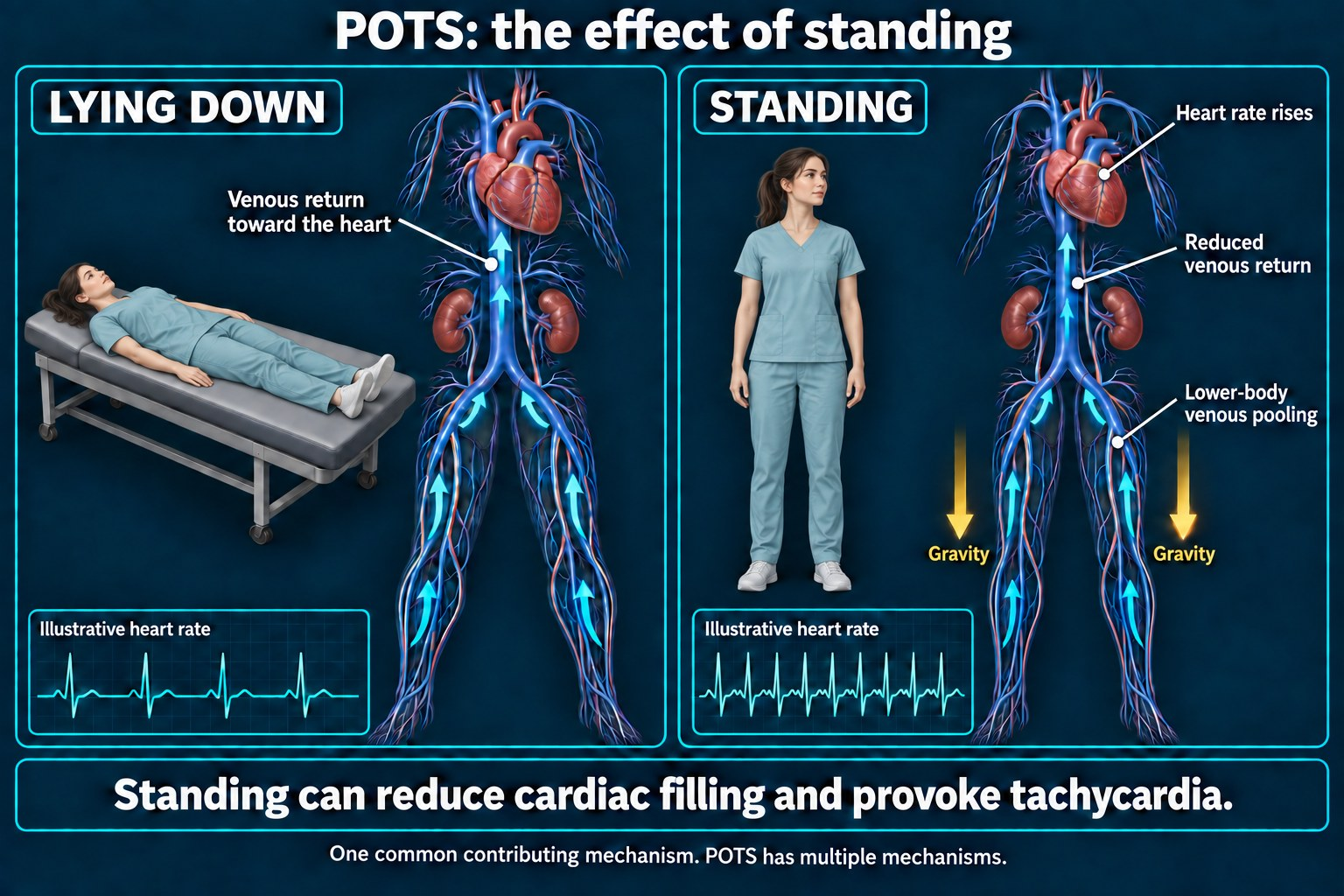
Postural orthostatic tachycardia syndrome is defined as a sustained heart rate increase of more than 30 beats per minute within ten minutes of standing, with symptoms of orthostatic intolerance and without associated hypotension (no sustained fall >20/10 mmHg), persisting more than three months.1,7 In adolescents aged 12–19 years the required increase is at least 40 beats per minute rather than 30.7 Most of what makes it difficult perioperatively follows from one thing: these patients tolerate volume depletion badly, and the perioperative pathway is built around fasting.
Key takeaways
- Fasting is the biggest modifiable risk. Prolonged NPO time is poorly tolerated, and reported management centers on adequate preoperative hydration.
- Ask for the first case of the day or a clear-fluid allowance up to two hours — this is the single most useful accommodation, and the current fasting guidance actively supports it.8,9
- Induction positioning matters, and published case management specifically emphasizes careful positioning during induction.
- Emergence is the second danger point. Hemodynamic lability may persist, and extended monitored observation is reasonable.
- Surgery and bed rest can worsen POTS themselves. POTS often follows an inciting event — infection, surgery, or enforced bed rest — and postoperative deconditioning can perpetuate it, which raises the value of early mobilization.14
- Bring the medication list. Midodrine, fludrocortisone, ivabradine, beta blockers and salt loading regimens all change the plan.
- POTS travels with other diagnoses — hypermobile EDS, mast cell activation syndrome, gastroparesis — and each adds its own consideration.
Who gets POTS, and why surgery itself matters
POTS predominantly affects women between roughly 15 and 45 years of age.16 It is not usually idiopathic in the sense of arriving from nowhere: it typically results from an inciting event — infection (including SARS-CoV-2), surgery, or enforced bed rest — in a susceptible individual, followed by a downward spiral of orthostatic intolerance, more bed rest, and worsening cardiovascular deconditioning that further exacerbates symptoms.14 Two things follow for the perioperative team. First, the operation and the recovery period are themselves potential triggers or aggravators, so early mobilization and adequate monitored recovery are not just comfort measures. Second, a patient whose POTS began after a previous surgery or a viral illness is telling you something clinically useful about their susceptibility.
Why the perioperative pathway is hostile to POTS
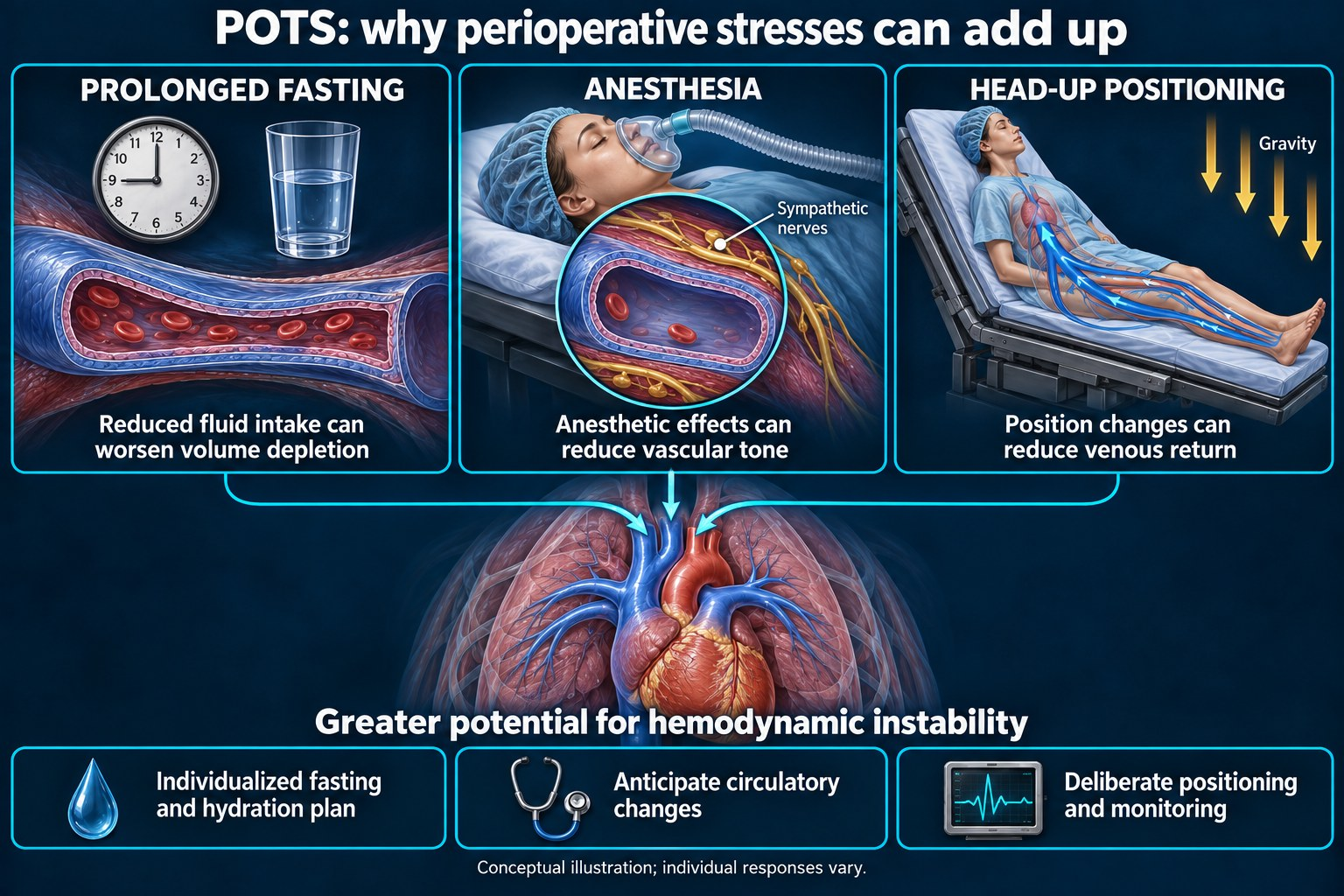
The mechanism is not exotic. POTS patients maintain cerebral perfusion and blood pressure through compensations that depend on intravascular volume and sympathetic tone. Fasting removes the volume. Anesthesia removes the sympathetic tone. Positioning changes remove the postural compensation. The three arrive together.
| Standard step | Why it is harder here |
|---|---|
| Midnight NPO | These patients are frequently volume-depleted at baseline and depend on high fluid and salt intake. A 12-hour fast is a substantial deficit before anything else happens5 |
| Induction | Sympatholysis on top of an already-depleted circulation. Careful positioning during induction is specifically emphasized in published case management1 |
| Neuraxial technique | Sympathectomy removes the compensation these patients rely on most. The published handling is obstetric — an epidural sited early, titrated slowly after an adequate fluid preload, to limit hypotension and the tachycardia that follows3 |
| Emergence and transfer | Upright posture is the provocation that defines the condition, and the reported handover to recovery staff covered position changes and the vital sign fluctuations that can follow them.1 Sequential position changes with a fresh sympathectomy or residual anesthetic are the hazard |
| Discharge home | Reduced oral intake after nausea, plus the same orthostatic problem, without monitoring |
Note what the case report does and does not establish. It describes extensive preoperative evaluation, intravenous hydration given before sedative or anesthetic medication, careful positioning at induction, gentle emergence and extubation, and a handover to recovery staff covering position changes and vital sign fluctuations.1 It does not discuss neuraxial anesthesia at all. That the sympathetic block of a spinal or epidural removes the compensation these patients depend on is inference from the physiology rather than a recommendation from that paper, and so is the hazard of stacking position changes on top of a fresh one. What has been published on neuraxial technique in POTS is obstetric.3,4
This is in the app, with the calculators and the drug library — free tier, no card. Get it →
What good management looks like
The published case literature is small but consistent. In two young women with POTS and hypermobile EDS presenting for general anesthesia, management centered on extensive preoperative evaluation, adequate preoperative hydration, careful positioning during induction, gentle emergence and extubation, and robust communication with postoperative caregivers.1
Before the day
- Establish the baseline. Usual resting and standing heart rate, usual blood pressure, and what the patient’s own warning symptoms are.
- Get the medication list and decide on each item — midodrine, fludrocortisone, ivabradine, beta blockers, pyridostigmine, salt tablets. Which continue on the morning of surgery is a decision to make in advance with the prescriber, not at the pre-op desk. Two specifics worth noting: fludrocortisone can cause hypokalemia, so check potassium; and ivabradine requires effective contraception in patients of childbearing potential — relevant in this predominantly young female population.10
- Know the POTS subtype where documented. In the hyperadrenergic subtype, nonselective beta-blockade (e.g., propranolol) is preferred, and several routine perioperative and adjunctive agents — opioids, diuretics, vasodilators, and others — can worsen orthostatic intolerance and should be used thoughtfully.11,15
- Ask about co-diagnoses. Hypermobile EDS, mast cell activation syndrome and gastroparesis co-occur frequently and each changes something — positioning, agent selection, aspiration risk. The overlap is substantial: roughly one-third of hEDS/HSD patients have orthostatic intolerance and about one in five carry a POTS diagnosis, and in surveyed hEDS/HSD cohorts around 37% report a POTS diagnosis.12,13 On aspiration risk specifically, gastric emptying in POTS is abnormal in a large minority but in both directions — delayed in about 18% and rapid in up to 48% — so do not assume every POTS patient has gastroparesis.11
- Ask what happened last time. Previous anesthetic records are the highest-yield item in any condition with a thin evidence base.
On the day
- Minimize the fast. First case, and clear fluids to two hours where institutional policy allows.6,8,9 Both the 2023 ASA modular update and a 2026 international multidisciplinary consensus reaffirm clear liquids until two hours and explicitly encourage institutional protocols that liberalize clear-liquid intake to reduce the harms of prolonged fasting — precisely the accommodation these patients need.8,9
- Intravenous fluid before induction rather than after hypotension. This is the intervention the case literature emphasizes.1
- Have a vasopressor drawn up before induction, not after the first reading.
- Move the patient deliberately. Position before induction where possible; avoid abrupt head-up changes on emergence.
Afterward
- Extended monitored observation is reasonable — a recent obstetric case report describes exactly this approach in a patient with POTS among other comorbidities.2
- Treat nausea aggressively, because vomiting reproduces the volume problem.
- Restore oral intake early, including salt.
- Mobilize early and sit the patient up in stages before expecting them to stand — postoperative bed rest and deconditioning can worsen POTS.14
An honest note on the evidence. There is no society guideline for the perioperative management of POTS. What exists is case reports, small series, and reasoning from the physiology — which is why previous anesthetic records and the patient’s own knowledge of their condition carry more weight here than they would elsewhere. A 2026 JAMA review gives the most current overview of diagnosis and treatment but likewise does not address perioperative care.7 Most POTS patients know their triggers precisely. That information is clinical data.
For patients: what to say, and how
Many POTS patients arrive at a pre-op interview expecting not to be believed. The way to make the conversation productive is to give the anesthesia provider things they can act on.
- “I have POTS. My baseline heart rate lying down is X and standing is Y.” A number is harder to dismiss than a label.
- “Prolonged fasting makes me significantly worse. Can I be scheduled first, or have clear fluids until two hours before?” This is a concrete, grantable request.
- “I take midodrine at these times and fludrocortisone daily. What would you like me to do on the morning of surgery?” Asking the question surfaces the decision.
- “I also have hypermobile EDS / MCAS / gastroparesis.” Each of these changes the plan independently.
- “Here are records from my last anesthetic.” The single most useful thing you can bring.
Frequently asked questions
Is anesthesia safe with POTS?
Yes, with planning. Published case management in POTS patients undergoing general anesthesia reports good outcomes with extensive preoperative evaluation, adequate preoperative hydration, careful positioning during induction, gentle emergence, and communication with postoperative caregivers.1 The risks are predictable rather than mysterious, and most of them relate to volume status and positioning.
Why is fasting such a problem with POTS?
Because POTS patients maintain blood pressure and cerebral perfusion through compensations that depend heavily on intravascular volume, and many maintain high fluid and salt intake for exactly that reason. A prolonged fast removes that volume before anesthesia removes the sympathetic tone that was compensating for it. Adequate preoperative hydration is the intervention the case literature emphasizes most,1 and current fasting guidance supports clear liquids until two hours and more liberal institutional protocols.8,9
Should I take my midodrine or fludrocortisone on the morning of surgery?
That should be decided in advance with the prescriber rather than at the pre-op desk. Bring the full list with doses and timings, and ask the question specifically — including salt tablets and any beta blocker or ivabradine. Note that the brand Corlanor was discontinued in the United States as of January 2026, though ivabradine remains available and is used off-label in POTS; it requires effective contraception in patients of childbearing potential.10,16
Can I have a spinal or epidural with POTS?
It is not contraindicated. A retrospective series of nine pregnancies in seven women with POTS reports epidural anesthesia in five of seven vaginal deliveries without associated complications, and concludes that regional anesthesia can be undertaken safely in this group.4 The consideration is that neuraxial sympathectomy removes exactly the compensation these patients depend on — physiology rather than something the POTS case literature states — so the hemodynamic plan needs to account for it: adequate volume beforehand, slow titration, and a vasopressor prepared rather than fetched. That is close to what one published obstetric case describes.3 Discuss it specifically rather than assuming either that it is fine or that it is off the table.
What should I tell my anesthesiologist about POTS?
Your baseline lying and standing heart rate, that prolonged fasting makes you worse and whether you can be scheduled early, your full medication list with timings, any co-occurring diagnoses such as hypermobile EDS, mast cell activation syndrome or gastroparesis, and records from any previous anesthetic.
Is POTS related to Ehlers-Danlos syndrome?
They co-occur frequently. About one-third of hypermobile EDS/HSD patients have orthostatic intolerance and roughly one in five carry a POTS diagnosis, while in surveyed hEDS/HSD cohorts around 37% report a POTS diagnosis.12,13 Where both are present each contributes its own perioperative considerations — dysautonomia and volume dependence from POTS, joint and skin fragility and local anesthetic resistance from EDS. The full picture is on the Ehlers-Danlos page.
References
- Laserna A, Nishtar M, Vidovich C, Borovcanin Z. Perioperative management of Ehlers-Danlos type III syndrome associated with postural orthostatic tachycardia in patients undergoing general anesthesia. Cureus. 2021;13(11):e19311. doi:10.7759/cureus.19311. Source of the diagnostic definition, of preoperative evaluation and intravenous hydration before sedative or anesthetic medication, of careful positioning at induction, of gentle emergence and extubation, and of the handover to recovery staff covering position changes and vital sign fluctuations. It does not address neuraxial technique.
- Aljuba YM, Shatalin D, Ronenson A, Grenader A, Ioscovich A. Anesthetic management of a pregnant patient with Ehlers-Danlos syndrome undergoing elective cesarean delivery: a case report. Cureus. 2025;17(8):e89400. doi:10.7759/cureus.89400. Describes extended post-anesthesia observation in a patient with POTS among multiple comorbidities.
- Corbett WL, Reiter CM, Schultz JR, Kanter RJ, Habib AS. Anaesthetic management of a parturient with the postural orthostatic tachycardia syndrome: a case report. Br J Anaesth. 2006;97(2):196–199. doi:10.1093/bja/ael105. PMID 16698864. Source of the early epidural and of slow titration after an adequate fluid preload to minimize hypotension and the subsequent tachycardia. Abstract read; the full text is subscription-only.
- Powless CA, Harms RW, Watson WJ. Postural tachycardia syndrome complicating pregnancy. J Matern Fetal Neonatal Med. 2010;23(8):850–853. doi:10.3109/14767050903265089. PMID 20136369. Nine pregnancies in seven women with POTS; epidural anesthesia in five of seven vaginal deliveries without associated complications, concluding that regional anesthesia can be undertaken safely. Abstract read; the full text is subscription-only.
- Sarin A, Chen LL, Wick EC. Enhanced recovery after surgery—preoperative fasting and glucose loading—a review. J Surg Oncol. 2017;116(5):578–582. doi:10.1002/jso.24810. PMID 28846137. Source of fasts of 12 hours or more under a nothing-by-mouth-after-midnight policy and operating room delays, and of prolonged fasting depriving patients of hydration.
- American Society of Anesthesiologists Task Force on Preoperative Fasting. Practice guidelines for preoperative fasting and the use of pharmacologic agents to reduce the risk of pulmonary aspiration: application to healthy patients undergoing elective procedures. Anesthesiology. 2017;126(3):376–393. doi:10.1097/ALN.0000000000001452. PMID 28045707. Source of the two-hour clear-liquid interval. Its recommendations are written for healthy patients having elective procedures.
- Chung TH, Raj SR. Postural orthostatic tachycardia syndrome (POTS): a review. JAMA. 2026. Current diagnostic criteria, including the ≥40 beats/min threshold for individuals aged 12–19 years and the requirement for symptoms ≥3 months without orthostatic hypotension; also the contemporary overview of workup and treatment. Does not address perioperative management.
- Joshi GP, Abdelmalak BB, Weigel WA, et al. 2023 American Society of Anesthesiologists practice guidelines for preoperative fasting: carbohydrate-containing clear liquids with or without protein, chewing gum, and pediatric fasting duration—a modular update of the 2017 guidelines. Anesthesiology. 2023;138(2):132–151. Reaffirms clear liquids until 2 h to minimize the harms of prolonged fasting; notes some comorbidities traditionally believed to delay gastric emptying may have little effect.
- Rüggeberg A, El-Boghdadly K, Bilotta F, et al. Peri-operative fasting in adults: an international, multidisciplinary consensus statement. Anaesthesia. 2026. PMID 41657234. Recommends encouraging clear liquids until 2 h and implementing institutional protocols that allow more liberal clear-liquid intake at <2 h before anesthesia or sedation.
- Robbins NM, Golden EP, Freeman KC, et al. Approach to postural orthostatic tachycardia syndrome. Neurol Clin Pract. 2026. First-line pharmacotherapy and dosing: midodrine (tachyphylaxis; avoid round-the-clock dosing), fludrocortisone (hypokalemia; potassium supplementation), and ivabradine (photopsias; contraception required in people of childbearing potential).
- Katz J, Angeli AM, Alicea A, Austin K. Gastrointestinal manifestations and nutrition support in hypermobile Ehlers-Danlos, postural orthostatic tachycardia, and mast cell activation syndromes. Curr Gastroenterol Rep. 2026. In POTS, studies show both delayed (~18%) and rapid (up to 48%) gastric emptying; hEDS/HSD have increased prevalence of gastroparesis versus controls.
- Kulin D, Holtmann G, Fairlie T, et al. Meta-analysis: chronic gastrointestinal symptoms and comorbidities in hypermobile Ehlers–Danlos syndrome and hypermobility spectrum disorders. Aliment Pharmacol Ther. 2026. One-third of hEDS/HSD patients have orthostatic intolerance; nearly 20% are diagnosed with POTS.
- Aziz Q, Harris LA, Goodman BP, Simrén M, Shin A. AGA clinical practice update on GI manifestations and autonomic or immune dysfunction in hypermobile Ehlers-Danlos syndrome: expert review. Clin Gastroenterol Hepatol. 2025. In a survey of 616 hEDS/HSD patients, 37.5% reported a POTS diagnosis; overlapping MCAS/POTS/EDS figures reported.
- Cornwell WK, Levine BD, Baptiste D, et al. Exercise intolerance and response to training in patients with postacute sequelae of SARS-CoV-2 (Long COVID): a scientific statement from the American Heart Association. Circulation. 2025. POTS typically follows an inciting event (infection, surgery, enforced bed rest) with a deconditioning spiral; may coexist with EDS and other conditions.
- Zadourian A, Doherty TA, Swiatkiewicz I, Taub PR. Postural orthostatic tachycardia syndrome: prevalence, pathophysiology, and management. Drugs. 2018;78(10):983–994. Lists drugs that may cause or worsen orthostatic intolerance; nonselective beta-blockers such as propranolol may particularly benefit the hyperadrenergic subtype.
- U.S. Food and Drug Administration. Orange Book: approved drug products with therapeutic equivalence evaluations. Source of the Corlanor (ivabradine) brand-discontinuation status in the United States.
Further reading
- Perioperative care in patients with Ehlers-Danlos syndromes. Review covering coexisting dysautonomia, mast cell activation syndrome and gastroparesis, and the intraoperative implications of each.
Disclaimer. Reference information for licensed clinicians and students. Not a medical device, and not a substitute for clinical judgment. There is no society guideline for the perioperative management of POTS; the guidance here derives from case reports and physiologic reasoning. Verify against your institutional protocol.
Conditions like this one, with their perioperative implications, ship inside Helix Anesthesia — a point-of-care reference built by a practicing CRNA, cited and available offline. See how we source clinical content.
Built for the anesthesia machine, not the desk. It opens in one tap, works with no signal in an OR that has none, and shows the citation on screen beside the number rather than making you go and find it.
Free tier, no card: every calculator, every crisis checklist, the full drug library and glossary, three complete regional blocks, five complete surgical cases, and 15 AI questions a month.
Get Helix Anesthesia How we source itSign up for our newsletter and special offers. New answer pages, improvements to the ones already here, and the occasional offer. Nothing else, and not often.
Hypermobility and dysautonomia
- Ehlers-Danlos syndrome — start here
- Mast cell activation syndrome