
Rocuronium vs succinylcholine for RSI
Succinylcholine gives better intubating conditions — except at the dose rocuronium is actually given for RSI, where the difference in conditions disappears. But conditions are not first-pass success, and duration is not free.
Every clinical claim on this page is cited to its source below. How we source clinical content.
The short answer
Succinylcholine produces better excellent intubating conditions overall, but the Cochrane meta-analysis found that advantage only against rocuronium 0.6–0.7 mg/kg, with no statistical difference at 0.9–1.0 mg/kg or at 1.2 mg/kg. The “it wears off as a rescue” argument does not survive scrutiny: critical desaturation precedes return to an unparalyzed state. Where sugammadex is immediately available, rocuronium plus sugammadex restores spontaneous ventilation faster than spontaneous succinylcholine recovery. Two caveats keep this from being one-sided: the largest randomized trial at the RSI dose (CURASMUR, rocuronium 1.2 mg/kg) did not show rocuronium noninferior for first-pass success, and rocuronium’s long duration carries a real risk of awareness with paralysis. Allergy/anaphylaxis is a contraindication for both drugs — and is reported more often with succinylcholine — while succinylcholine additionally carries a long list of other contraindications.
The traditional argument for succinylcholine has two parts: better intubating conditions, and a short duration that lets the patient wake up if intubation fails. The first part is true at low rocuronium doses and disappears at high ones. The second part was questionable before sugammadex existed and is now largely reversed — but “equivalent conditions” should not be read as “equivalent first-pass success,” and rocuronium’s duration is itself a safety exposure.
Key takeaways
- Succinylcholine produces better excellent intubating conditions overall — but the Cochrane meta-analysis found no statistical difference against rocuronium at 0.9–1.0 mg/kg or 1.2 mg/kg.
- The advantage holds only against low-dose rocuronium (0.6–0.7 mg/kg).
- But conditions are not the same as first-pass success. In CURASMUR — the largest RCT at the RSI dose — rocuronium 1.2 mg/kg did not meet noninferiority versus succinylcholine for first-pass intubation success.10
- The “it wears off” rescue argument does not survive scrutiny. Critical desaturation occurs before return to an unparalyzed state after succinylcholine 1 mg/kg.
- Rocuronium plus sugammadex re-establishes spontaneous ventilation faster than spontaneous succinylcholine recovery in a randomized trial — where sugammadex is immediately available.
- Rocuronium’s long duration risks awareness with paralysis if post-intubation sedation lags — a hazard succinylcholine’s short duration structurally limits.11,18
- Allergy/anaphylaxis contraindicates both drugs and is reported more frequently with succinylcholine; succinylcholine additionally has a long list of other contraindications, rocuronium does not.
- In critically ill patients, desaturation rates were no different between the two.
Intubating conditions: the dose is most of the argument
The Cochrane systematic review pooled 50 trials and 4,151 participants.1,2
| Comparison | Result |
|---|---|
| Overall — excellent intubating conditions | Succinylcholine superior, RR 0.86 (95% CI 0.81–0.92); ARR 12%, NNT 83 |
| Overall — clinically acceptable conditions | RR 0.97 (95% CI 0.95–0.99) — statistically significant, clinically marginal |
| Rocuronium 0.9–1.0 mg/kg | RR 0.95 (95% CI 0.89–1.00) — essentially no difference |
| Rocuronium 1.2 mg/kg | No statistical difference from succinylcholine (3 trials, 86 participants)2 |
This is why the same review can be cited by both sides. The headline conclusion — succinylcholine created superior intubating conditions — is accurate, and so is the finding that no difference exists at the doses actually used for rapid sequence induction. The authors’ own reasoning for still preferring succinylcholine at 1.2 mg/kg was that it is “clinically superior as it has a shorter duration of action”2 — which is the second argument, not the first.
Other trials support the equivalence in conditions at proper dose. In 401 critically ill patients requiring emergent RSI, randomized to succinylcholine 1 mg/kg or rocuronium 0.6 mg/kg, there was no difference in oxygen desaturation.4 A randomized trial in elderly patients found excellent intubating conditions in 73% versus 75% (p = 0.82).5
The trial the Cochrane review predates: CURASMUR
The single largest randomized trial addressing the RSI dose directly is CURASMUR (Guihard et al., JAMA 2019). In 1,248 out-of-hospital RSI patients randomized to succinylcholine 1 mg/kg or rocuronium 1.2 mg/kg, first-pass intubation success was 79.4% with succinylcholine versus 74.6% with rocuronium; rocuronium did not meet the prespecified noninferiority margin (absolute difference −4.8%, one-sided 97.5% CI −9% to ∞; margin 7%).10 This does not overturn the Cochrane intubating-conditions finding, but it is a direct caution against reading “no difference in conditions” as “interchangeable for first-pass success.”
The 2023 Society of Critical Care Medicine RSI guideline for critically ill adults is the current authoritative synthesis: across studies it found first-pass success not significantly different between the two agents and no clear overall mortality difference.11
This is in the app, with the drug library and airway checklists — free tier, no card. Get it →
The rescue argument, examined
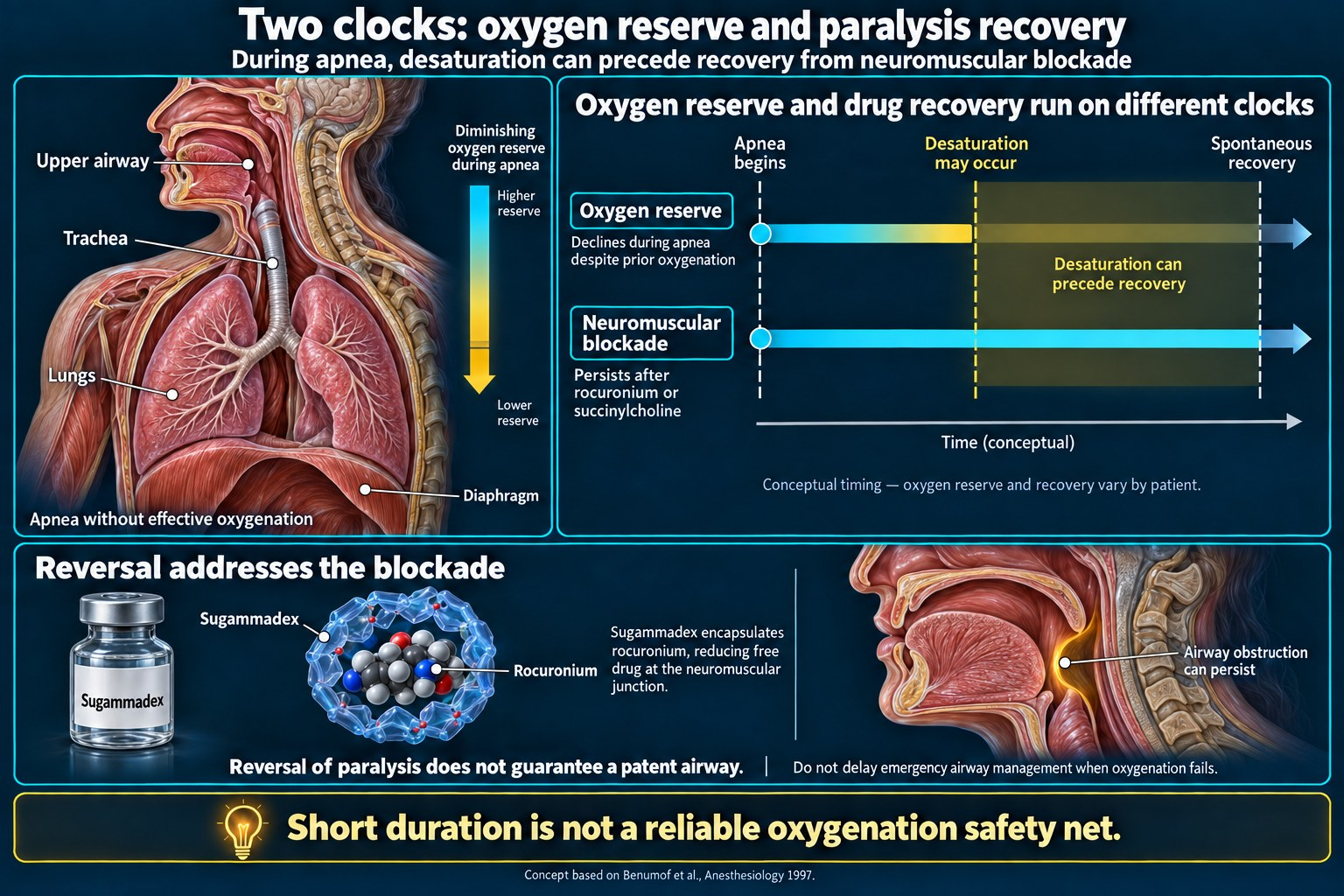
The reasoning is intuitive: if intubation fails, succinylcholine wears off in six to ten minutes and the patient resumes breathing. The evidence undermines it.
First: critical desaturation occurs before the patient is unparalyzed. Benumof and colleagues modeled that critical hemoglobin desaturation will occur before return to an unparalyzed state following succinylcholine 1 mg/kg intravenously.6 Volunteer and patient data confirm the model: after succinylcholine 1 mg/kg apnea, SpO₂ fell below 95% in roughly half of healthy volunteers and below 80% in about a third before spontaneous ventilation returned (Heier),13 and 11% of patients desaturated to ≤90% before recovery regardless of preoxygenation technique (Hayes).14 A patient who cannot be intubated or ventilated does not have the six to ten minutes the argument assumes — they have the duration of their own oxygen reserve, which is shorter.
Second: rocuronium plus sugammadex is faster. In a randomized, patient- and observer-blinded trial, RSI with rocuronium 1 mg/kg followed by sugammadex 16 mg/kg after intubation allowed earlier re-establishment of spontaneous ventilation than succinylcholine 1 mg/kg (median 216 vs 406 s).7 A separate comparison reversing rocuronium three minutes after dosing found the same direction of effect.15
The authors of the Sørensen trial were careful about what it does and does not show: they did not study a can’t-intubate-can’t-ventilate situation, where the answer is a front-of-neck airway rather than reversal.7 The scenario it does speak to is the more common one — a skilled operator recognizing early, before desaturation, that intubation will not succeed and wanting the patient back.
That distinction matters. Sugammadex is a rescue for failed intubation with maintained oxygenation. It is not a substitute for a surgical airway once oxygenation has failed.
Note the desaturation picture is not one-directional either: in overweight patients, succinylcholine produced faster desaturation and a shorter safe apnea time than rocuronium (283 vs 329 s; Tang) — which reinforces, rather than weakens, the point that succinylcholine’s short duration is not a reliable oxygenation safety net.16
The trade-off the contraindication count hides: awareness with paralysis
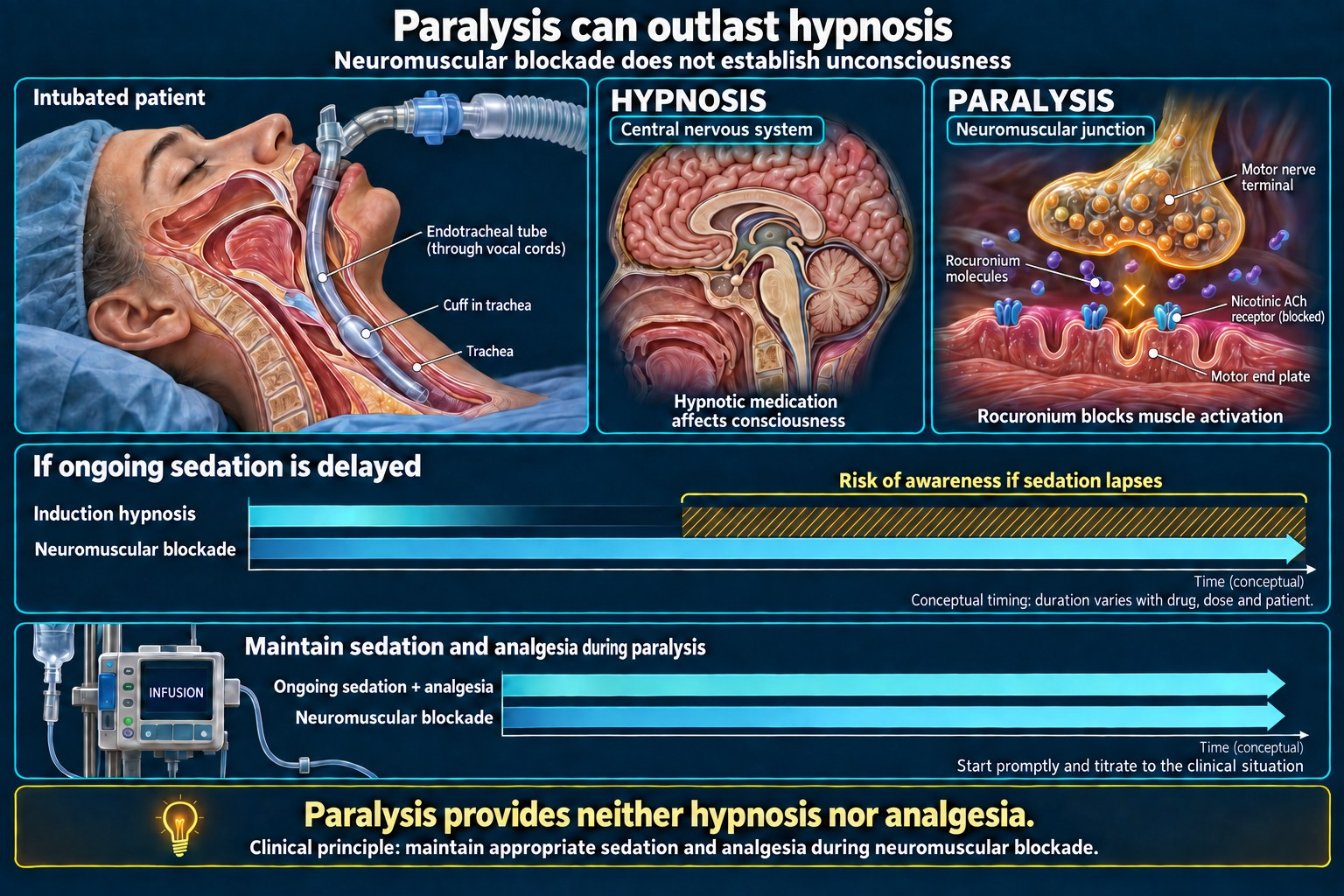
Rocuronium’s long duration is not only an inconvenience where sugammadex is unavailable — it is a patient-safety exposure. A patient paralyzed for 40–70+ minutes who is under-sedated can be awake and paralyzed. The 2023 SCCM RSI guideline and recent evidence reviews flag accidental awareness with paralysis as a specific hazard of longer-acting agents, requiring that post-intubation sedation and analgesia be started promptly and titrated.11,18 Succinylcholine’s short duration structurally limits this window; rocuronium does not. This is the genuine counterweight to the “rocuronium has a shorter contraindication list” argument.
The contraindications
| Succinylcholine | Rocuronium |
|---|---|
| Hypersensitivity/anaphylaxis to succinylcholine (reported more frequently than with rocuronium)12 Known or susceptibility to hyperkalemia Major burns, multiple trauma, extensive denervation, or upper motor neuron injury — after the acute phase (risk rises ~3–5 days after injury, ~7–10 days after burns; a ~24–48 h window is a bedside heuristic, not the label wording)12,19 Denervation syndromes Skeletal muscle myopathies (e.g., muscular dystrophy) Personal or familial malignant hyperthermia susceptibility Prolonged immobilization3,12 | Hypersensitivity/allergy to rocuronium3 |
Allergy is a contraindication for both agents — not a point of difference. The meaningful contrast is the rest of the succinylcholine list. If anything, anaphylaxis to a neuromuscular blocker is reported more often with succinylcholine than with rocuronium, so “rocuronium’s only contraindication is allergy” should not be read as “rocuronium is the safer choice for the allergic patient.”12
Succinylcholine also causes bradycardia and asystole, plasma potassium elevation, and myalgia.8 Rocuronium has little or no adverse cardiovascular effect and does not release histamine, which is why it may be preferred in patients in whom hemodynamic change is to be minimized.9
Duration, and what it costs
Succinylcholine lasts roughly 6–10 minutes.3 Rocuronium lasts roughly 37–72 minutes at standard doses,2,3 and longer as the dose rises: 73 ± 32 minutes at 1.2 mg/kg in the study the Cochrane review cites.2 Where sugammadex is unavailable, that is a genuine and substantial difference, and it is the strongest remaining argument for succinylcholine.
Where sugammadex is available and immediately at hand, the calculation changes: rocuronium 1.2 mg/kg gives intubating conditions that are not statistically different from succinylcholine, immediate reversal is faster than spontaneous recovery, and the additional (non-allergy) contraindication list is empty.
“Immediately at hand” is doing real work in that sentence. Sugammadex 16 mg/kg is a large dose. The 16 mg/kg dose is FDA-labeled specifically for immediate reversal after rocuronium 1.2 mg/kg;17 the Sørensen trial used rocuronium 1 mg/kg with that same 16 mg/kg dose.7 If the drug is in a locked cupboard, in the pharmacy, or in a quantity insufficient for a 16 mg/kg dose, the rescue argument does not apply to your institution regardless of what the literature says. The dosing detail is on the sugammadex dosing page.
The practical reading
- If you use rocuronium for RSI, dose it for RSI. The equivalence in intubating conditions holds from 0.9–1.0 mg/kg upward (at 1.2 mg/kg it rests on only 3 trials and 86 participants) and is lost at 0.6–0.7 mg/kg.
- Do not read equivalent conditions as equivalent first-pass success. CURASMUR, the largest RSI trial at 1.2 mg/kg, did not show rocuronium noninferior.10
- Start post-intubation sedation immediately after rocuronium. Its long duration risks awareness with paralysis if sedation lags.11,18
- Check what a 16 mg/kg dose means at your institution — how many vials, where they are, and how long it takes to get them.
- Do not treat succinylcholine’s duration as a safety net in a patient who is difficult to oxygenate. The desaturation data say the net is not there.
- Where succinylcholine is contraindicated the question does not arise, and its (non-allergy) contraindication list is long enough that this is a frequent situation.
- Sugammadex is not the answer to can’t-intubate-can’t-oxygenate. That is a front-of-neck problem, and reaching for reversal instead costs time.
Frequently asked questions
Is rocuronium as good as succinylcholine for RSI?
For intubating conditions, at the right dose, yes. The Cochrane review of 50 trials and 4,151 participants found succinylcholine superior overall for excellent intubating conditions (RR 0.86), but no statistical difference against rocuronium at 1.2 mg/kg, and RR 0.95 (0.89–1.00) at 0.9–1.0 mg/kg.1,2 Succinylcholine was superior only against 0.6–0.7 mg/kg.2 For first-pass success, the largest randomized trial (CURASMUR) did not show rocuronium 1.2 mg/kg noninferior to succinylcholine (79.4% vs 74.6%).10
Does succinylcholine wear off fast enough to rescue a failed intubation?
Not reliably. Critical hemoglobin desaturation occurs before return to an unparalyzed state after succinylcholine 1 mg/kg,6 a finding confirmed in volunteers and patients.13,14 A patient who cannot be intubated or oxygenated has the duration of their oxygen reserve, not the duration of the drug.
Is rocuronium plus sugammadex faster than succinylcholine?
For re-establishing spontaneous ventilation, yes. A randomized, patient- and observer-blinded trial found that RSI with rocuronium 1 mg/kg followed by sugammadex 16 mg/kg allowed earlier return of spontaneous ventilation than succinylcholine 1 mg/kg (216 vs 406 s).7 The authors noted this does not address a can’t-intubate-can’t-ventilate situation, where a front-of-neck airway is the answer.
Does rocuronium risk awareness during RSI?
Yes, if sedation is not maintained. Because rocuronium can paralyze for 40–70+ minutes, an under-sedated patient can be awake and paralyzed. Guidelines and reviews highlight awareness with paralysis as a specific hazard of longer-acting agents and call for prompt, titrated post-intubation sedation.11,18 Succinylcholine’s short duration limits this window.
What dose of rocuronium is used for rapid sequence intubation?
The Cochrane review found no statistical difference from succinylcholine in intubating conditions at 0.9–1.0 mg/kg or at 1.2 mg/kg; succinylcholine was superior only against 0.6–0.7 mg/kg.2 The review found no conclusive evidence that increasing the dose improves intubating conditions, the 1.2 mg/kg comparison rests on only 3 trials and 86 participants, and higher doses last longer.2 TheNNT’s summary calls 0.9–1.0 mg/kg the recommended higher dose.3 Note that sugammadex 16 mg/kg is FDA-labeled for immediate reversal after the 1.2 mg/kg dose.17
When is succinylcholine contraindicated?
Hypersensitivity/anaphylaxis to succinylcholine; known or susceptibility to hyperkalemia; major burns, multiple trauma, extensive denervation or upper motor neuron injury after the acute phase; denervation syndromes; skeletal muscle myopathies (e.g., muscular dystrophy); personal or familial malignant hyperthermia susceptibility; and prolonged immobilization.3,12 It also causes bradycardia and asystole, potassium elevation and myalgia.8 Allergy is a contraindication for rocuronium too — so allergy is not a point of difference; anaphylaxis is in fact reported more often with succinylcholine.12
Can sugammadex rescue a can’t-intubate-can’t-oxygenate situation?
No, and treating it as though it can costs time. Sugammadex reverses paralysis; it does not open an obstructed airway or restore oxygenation in a patient who cannot be ventilated. The trial authors explicitly declined to extend their finding to that scenario.7 Once oxygenation has failed, the answer is a front-of-neck airway.
References
- Tran DTT, Newton EK, Mount VAH, Lee JS, Wells GA, Perry JJ. Rocuronium vs. succinylcholine for rapid sequence intubation: a Cochrane systematic review. Anaesthesia. 2017;72(6):765–777. PMID 28654173. Fifty trials, 4,151 participants.
- Tran DTT, Newton EK, Mount VAH, et al. Rocuronium versus succinylcholine for rapid sequence induction intubation. Cochrane Database Syst Rev. 2015;10:CD002788. PMID 26512948. Excellent conditions RR 0.86 (0.81–0.92, n = 4151); clinically acceptable RR 0.97 (0.95–0.99, n = 3992, 48 trials); succinylcholine superior against rocuronium 0.6–0.7 mg/kg, and no statistical difference against 0.9–1.0 mg/kg or 1.2 mg/kg (3 trials, 86 participants), with the authors’ reasoning that succinylcholine remains “clinically superior as it has a shorter duration of action.” Also the source of the 37–72 minute duration at standard doses and 73 ± 32 minutes at 1.2 mg/kg.
- Rocuronium vs. succinylcholine for rapid sequence intubation. TheNNT review of the Cochrane analysis. thennt.com/nnt/rocuronium-vs-succinylcholine-rapid-sequence-intubation. Reports the ARR of 12% and NNT of 8, the contraindication list, the duration figures of 6–10 minutes for succinylcholine and 37–72 minutes for rocuronium (a range it does not tie to a dose), and 0.9–1.0 mg/kg as the recommended higher dose of rocuronium.
- Marsch SC, Steiner L, Bucher E, et al. Succinylcholine versus rocuronium for rapid sequence intubation in intensive care: a prospective, randomized controlled trial. Crit Care. 2011;15:R199. doi:10.1186/cc10367. 401 critically ill patients.
- Intubating conditions during rapid sequence induction with either rocuronium or suxamethonium in elderly patients: a randomised study. PMC11798891. Excellent intubating conditions 73% versus 75% (p = 0.82).
- Benumof JL, Dagg R, Benumof R. Critical hemoglobin desaturation will occur before return to an unparalyzed state following 1 mg/kg intravenous succinylcholine. Anesthesiology. 1997;87(4):979–982. doi:10.1097/00000542-199710000-00034. PMID 9357902.
- Sørensen MK, Bretlau C, Gätke MR, Sørensen AM, Rasmussen LS. Rapid sequence induction and intubation with rocuronium–sugammadex compared with succinylcholine: a randomized trial. Br J Anaesth. 2012;108(4):682–689. doi:10.1093/bja/aer503. PMID 22315329. Time to spontaneous ventilation 216 vs 406 s; includes the authors’ reply to correspondence clarifying the can’t-intubate-can’t-ventilate limitation.
- Sørensen MK, et al., as above — Br J Anaesth. 2012;108(4):682–689. doi:10.1093/bja/aer503. PMID 22315329 — on the adverse effect profile of succinylcholine: bradycardia, asystole, plasma potassium elevation and muscle ache.
- Comparison of intubating conditions following administration of low-dose rocuronium or succinylcholine in adults: a randomized double blind study. PMC4173439. Notes rocuronium’s onset comparable to succinylcholine above 0.9 mg/kg and its lack of cardiovascular effect or histamine release.
- Guihard B, Chollet-Xémard C, Lakhnati P, et al. Effect of rocuronium vs succinylcholine on endotracheal intubation success rate among patients undergoing out-of-hospital rapid sequence intubation (CURASMUR): a randomized clinical trial. JAMA. 2019;322(23):2303–2312. PMID 31846014. 1,248 patients; first-pass success 79.4% (succinylcholine) vs 74.6% (rocuronium 1.2 mg/kg); rocuronium did not meet noninferiority (difference −4.8%, one-sided 97.5% CI −9% to ∞; margin 7%).
- Acquisto NM, Mosier JM, Bittner EA, et al. Society of Critical Care Medicine clinical practice guidelines for rapid sequence intubation in the critically ill adult patient. Crit Care Med. 2023;51(10):1411–1430. First-pass success not significantly different between agents; addresses awareness with paralysis and post-intubation sedation.
- Succinylcholine chloride injection. US FDA prescribing information (Anectine and generics), 2023–2025. DailyMed (Anectine). Contraindications: hypersensitivity to the drug; personal or familial history of malignant hyperthermia; skeletal muscle myopathies; and clinical states in which hyperkalemia would be aggravated (after the acute phase of injury following major burns, multiple trauma, extensive denervation of skeletal muscle, or upper motor neuron injury). Anaphylaxis/hypersensitivity reactions are reported and are more frequently associated with succinylcholine than with rocuronium.
- Heier T, Feiner JR, Lin J, Brown R, Caldwell JE. Hemoglobin desaturation after succinylcholine-induced apnea: a study of the recovery of spontaneous ventilation in healthy volunteers. Anesthesiology. 2001;94(5):754–759. PMID 11388524. After succinylcholine 1 mg/kg apnea, SpO₂ fell below 95% in roughly half and below 80% in about a third of subjects before spontaneous ventilation returned.
- Hayes AH, Breslin DS, Mirakhur RK, Reid JE, O'Hare RA. Frequency of haemoglobin desaturation with the use of succinylcholine during rapid sequence induction of anaesthesia. Acta Anaesthesiol Scand. 2001;45(6):746–749. PMID 11421834. 11% of patients desaturated to ≤90% before spontaneous ventilation returned, regardless of preoxygenation technique.
- Lee C, Jahr JS, Candiotti KA, et al. Reversal of profound neuromuscular block by sugammadex administered three minutes after rocuronium: a comparison with spontaneous recovery from succinylcholine. Anesthesiology. 2009;110(5):1020–1025. PMID 19387176. Rocuronium 1.2 mg/kg reversed with sugammadex 16 mg/kg three minutes later recovered faster than spontaneous recovery from succinylcholine 1 mg/kg.
- Tang L, Li S, Huang S, Ma H, Wang Z. Desaturation following rapid sequence induction using succinylcholine vs. rocuronium in overweight patients. Acta Anaesthesiol Scand. 2011;55(2):203–208. doi:10.1111/j.1399-6576.2010.02365.x. PMID 21226862. Safe apnea time 283 s (succinylcholine) vs 329 s (rocuronium); succinylcholine produced faster desaturation and slower recovery.
- Sugammadex (Bridion) injection. US FDA prescribing information, 2026. DailyMed (Bridion). The 16 mg/kg dose is indicated for immediate reversal of neuromuscular blockade after a single dose of rocuronium 1.2 mg/kg.
- DeMasi SC, Casey JD, Semler MW. Evidence-based emergency tracheal intubation. Am J Respir Crit Care Med. 2025. Discusses agent selection for RSI and the risk of accidental awareness with paralysis when longer-acting agents are used without adequate post-intubation sedation.
- Ko CL, Celmins L. Pharmacology for rapid sequence intubation (RSI): airway management in trauma patients. JOMI. 2024. Succinylcholine is generally considered safe in the initial ~24–48 hours after major burn or denervating injury; hyperkalemia risk develops as upregulation of extrajunctional acetylcholine receptors progresses (roughly 3–5 days after injury, peaking ~7–10 days after burns).
Disclaimer. Reference information for licensed clinicians and students. Not a medical device, and not a substitute for clinical judgment. Whether sugammadex rescue is available to you is an institutional question, not a literature one. Verify against your institutional protocol and current package inserts.
Drug entries, reversal intervals and airway checklists ship inside Helix Anesthesia — a point-of-care reference built by a practicing CRNA, cited and available offline. See how we source clinical content.
Built for the anesthesia machine, not the desk. It opens in one tap, works with no signal in an OR that has none, and shows the citation on screen beside the number rather than making you go and find it.
Free tier, no card: every calculator, every crisis checklist, the full drug library and glossary, three complete regional blocks, five complete surgical cases, and 15 AI questions a month.
Get Helix Anesthesia How we source itSign up for our newsletter and special offers. New answer pages, improvements to the ones already here, and the occasional offer. Nothing else, and not often.