
Drug-eluting stents: how long before surgery?
The single number most of us memorized is gone. The 2024 guideline replaced it with two, and which one applies depends on why the stent was placed rather than what kind of stent it is.
Every clinical claim on this page is cited to its source below. How we source clinical content.
The short answer
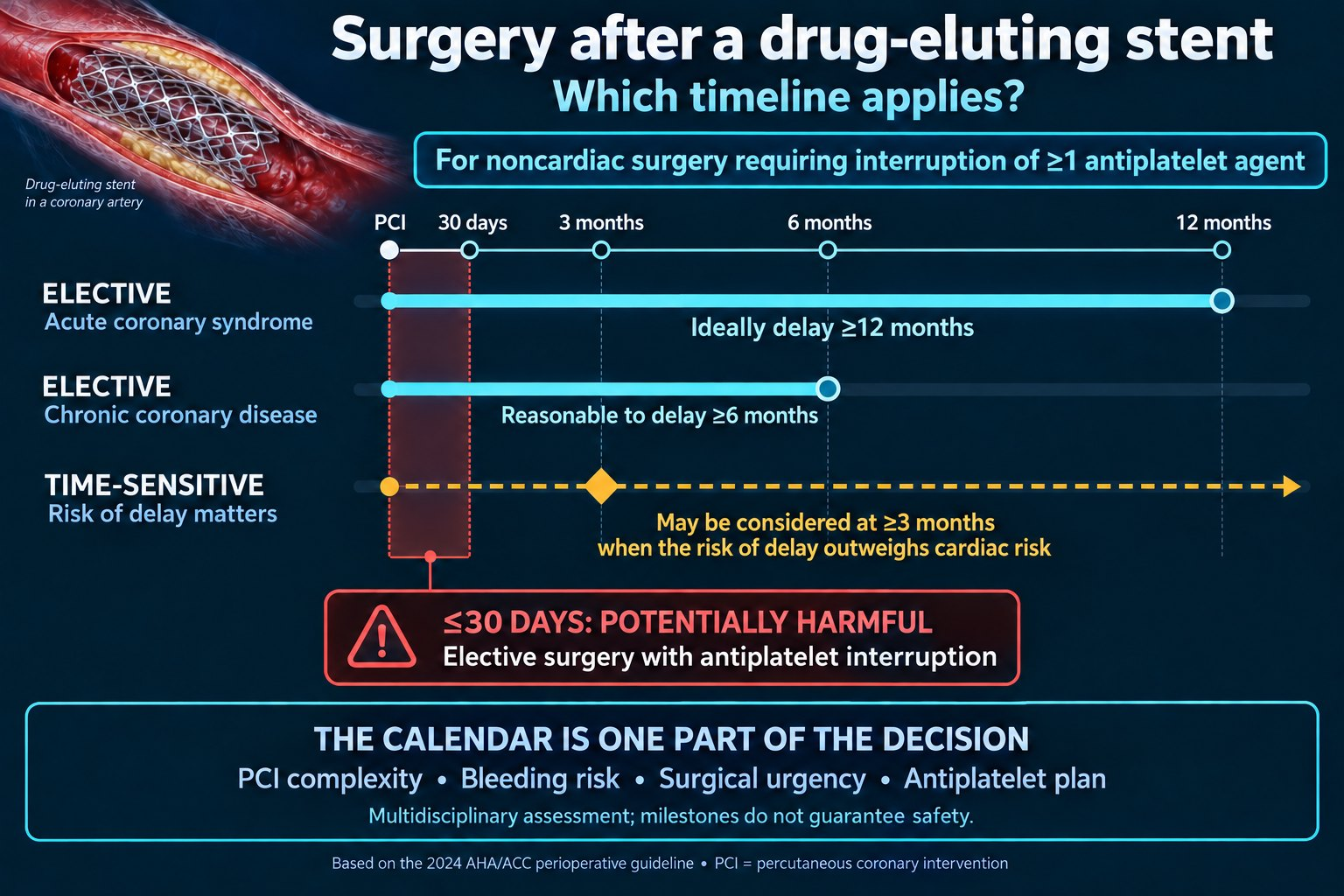
After a drug-eluting stent, delay elective noncardiac surgery at least 6 months if the stent was placed for chronic coronary disease, and at least 12 months if it was placed for an acute coronary syndrome. Time-sensitive surgery may go ahead at 3 months. Below 30 days, interrupting antiplatelet therapy is considered harmful.
If you trained before 2016 you learned one year. If you trained after the focused update on dual antiplatelet therapy duration that year, you probably learned six months.14 Both were reasonable readings of the guidance at the time, and neither is the current answer. The 2024 perioperative guideline splits the question in two, and the split is not by stent generation or stent type. It is by the clinical problem that put the stent in.
Key takeaways
- Drug-eluting stent placed for acute coronary syndrome: delay elective noncardiac surgery at least 12 months when at least one antiplatelet agent has to be interrupted (Class 1).1
- Drug-eluting stent placed for chronic coronary disease: it is reasonable to delay at least 6 months (Class 2a).1
- Twelve months may also be appropriate after complex intervention— bifurcation stents, long stent lengths, multivessel percutaneous coronary intervention.1,2
- Bare-metal stent: at least 30 days. Balloon angioplasty without a stent: at least 14 days.1
- Within 30 days of any stent, elective surgery requiring antiplatelet interruption is classified as potentially harmful (Class 3: Harm).1
- Time-sensitive surgery may proceed at 3 months after a drug-eluting stent when the risk of further delay outweighs the cardiac risk.1
- The definitions changed too. “Elective” now means indefinitely deferrable; “time-sensitive” now stretches to three months. That reframes the whole conversation.2
- Timing is not the strongest predictor. In the largest cohort, urgency of the operation and the patient’s underlying cardiac disease outranked it.4
How to read the recommendation classes. American College of Cardiology and American Heart Association guidelines grade recommendations two ways. Class is how strongly they mean it: Class 1 is “should,” Class 2a is “is reasonable,” Class 2b is “may be considered,” and Class 3 is either “not useful” or, in its stronger form, “harmful.” Level of evidence is what it rests on: A is high-quality randomized data, B-R is moderate randomized, B-NR is moderate non-randomized, and C-LD is limited data.
Most of the recommendations on this page are Class 1 or 2a resting on B-NR or C-LD — strong advice built on observational evidence, which matters when you are weighing a departure from it.
What the 2024 guideline says
The 2024 multi-society guideline for perioperative cardiovascular management supersedes the 2014 document entirely.1 These are its timing recommendations for patients with prior percutaneous coronary intervention facing noncardiac surgery.
| Situation | Recommendation | Class |
|---|---|---|
| Balloon angioplasty, no stent | Delay elective surgery a minimum of 14 days | 1 (C-LD) |
| Bare-metal stent | Delay elective surgery at least 30 days | — |
| Drug-eluting stent for acute coronary syndrome, elective surgery requiring interruption of ≥1 antiplatelet agent | Ideally delay ≥12 months | 1 (B-NR) |
| Drug-eluting stent for chronic coronary disease, elective surgery requiring interruption of ≥1 antiplatelet agent | Reasonable to delay ≥6 months | 2a |
| Complex drug-eluting stent placement — bifurcation stents, long stent lengths, multivessel intervention | 12 months may also be appropriate | — |
| Within 30 days of any stent, elective surgery requiring antiplatelet interruption | Potentially harmful — high risk of stent thrombosis and ischemic complications | 3: Harm (B-NR) |
| Time-sensitive surgery after a drug-eluting stent | May be considered at ≥3 months if the risk of delay outweighs the risk of a major adverse cardiac event | — |
| Any patient with coronary disease facing elective surgery | Timing and antiplatelet management determined by a multidisciplinary team with shared decision-making | 1 (B-NR) |
Why the indication now drives the number
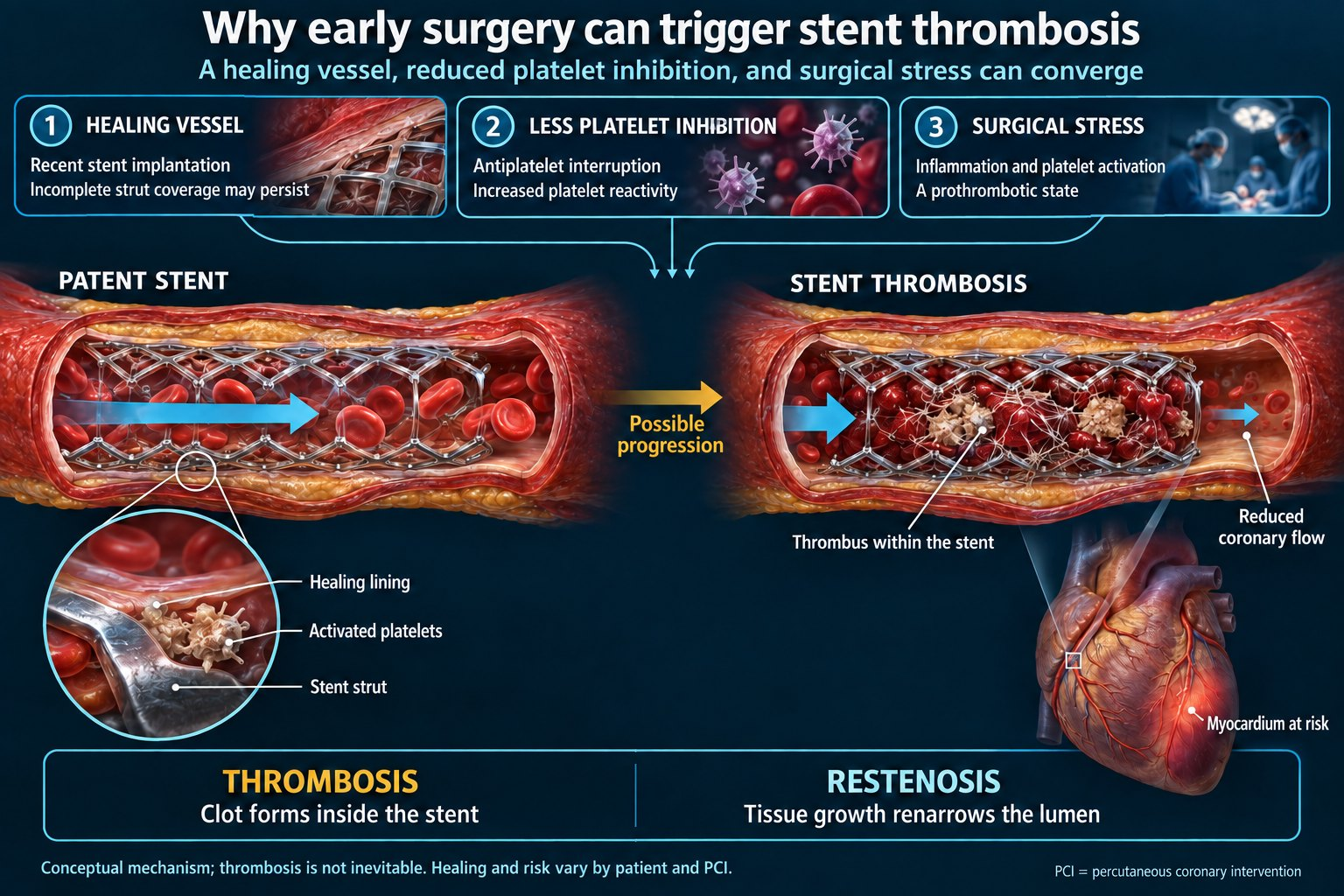
This is the conceptual shift worth internalizing. A patient stented after a myocardial infarction and a patient stented for stable angina can receive the identical stent, from the identical box, deployed by the identical operator — and carry meaningfully different perioperative risk afterward.
The stent is not the whole story. The plaque biology, the systemic inflammatory state, and the myocardium that was recently injured all travel with the patient into your operating room. The guideline’s split by indication is an acknowledgment that the risk being managed is not purely mechanical.
The “threefold” figure, and where it actually comes from. The number quoted for this — roughly three times the postoperative event risk after an acute coronary syndrome stent — comes from a congress abstract in which postoperative myocardial infarction was 1.9% after an acute coronary syndrome indication versus 0.6% after stable angina, odds ratio 3.21 (95% CI 1.76–5.83), 2.50 (1.35–4.61) adjusted.7 That cohort was later published in full,15 but the published analysis asks a different question: it compares each stented group against a matched general-population cohort without known coronary artery disease, not against the other. So the head-to-head ratio quoted in guidelines remains abstract-only, even though the underlying data are not.
Two things travel with it, and the full publication makes both of them sharper. The excess is concentrated in the first month: in the published cohort, acute coronary syndrome patients operated within one month of stenting had a 30-day infarction risk of 10% against 0.8%, adjusted odds ratio 20.1 (95% CI 8.85–45.6). Between one and twelve months it falls to 0.6% against 0.2%, adjusted odds ratio 2.18 (0.89–5.38), with the interval crossing 1. Stable angina patients sat at 0.4% against 0.2%, 1.90 (0.70–5.14). And mortality did not differ in any stratum. The authors conclude that patients operated between one and twelve months after stenting, for either indication, carried a risk of infarction and death similar to surgical patients with no known coronary disease.15The direction is real and it is the guideline’s own rationale; what the data locate is a first-month problem rather than a twelve-month one.
The definitions changed, and this one catches people out. The 2024 guideline redefined the surgical urgency categories.2 Emergency is now under 2 hours, down from 6. Urgent is 2 to 24 hours. Time-sensitive now extends to 3 months, where it used to mean 1 to 6 weeks. And elective now means the operation can be delayed indefinitely, where it previously meant it could be delayed up to a year.
That last one is not semantics. If an operation genuinely cannot be deferred indefinitely, it is not elective under this guideline, and the elective timing thresholds are not the ones that apply to it.
This is in the app, with the cardiac risk and hold-time tools — free tier, no card. Get it →
Where the numbers came from
Observational data does almost all of the work underneath these recommendations, which is why most of them, Class 1 included, rest on nonrandomized (B-NR) or limited-data (C-LD) evidence. Four cohorts are worth knowing in their own right, and they do not all point the same way.
The Ontario cohort: the shape of the risk curve
A population-based study of 8,116 patients who had major elective noncardiac surgery within ten years of receiving a coronary stent, compared against 341,350 surgical patients who had never been revascularized.3 The 30-day event rate — death, readmission for acute coronary syndrome, or repeat revascularization — traced a clear gradient.
| Interval from stent to surgery | 30-day major adverse cardiac event rate |
|---|---|
| Under 45 days, drug-eluting stent | 20.0% |
| Under 45 days, bare-metal stent | 6.7% |
| 45 to 180 days, bare-metal stent | 2.6% |
| Beyond 180 days, drug-eluting stent | 1.2% |
| All stented patients, overall | 2.1% |
One in five is not a subtle signal, and it is the single most persuasive number in this literature for not operating early. By six months the drug-eluting stent rate had fallen to a level approaching that of non-revascularized patients at intermediate risk. The authors concluded that the earliest optimal window for elective surgery was 46 to 180 days after a bare-metal stent, or beyond 180 days after a drug-eluting stent.3
The Veterans Affairs cohort: timing is not the main driver
A national retrospective cohort of 41,989 operations occurring within two years of stent placement, drawn from 124,844 stent implantations. Among 28,029 patients who had noncardiac surgery, there were 1,980 major adverse cardiac events, a rate of 4.7%.4
Time from stent to surgery was associated with events during the first six months and not beyond it. Crude event rates were 5.1% for bare-metal and 4.3% for drug-eluting stents, a statistically significant difference, but after adjustment stent type was not associated with events (odds ratio 0.91, 95% CI 0.83–1.01).4 The more instructive finding was which variables carried the most weight.
| Predictor | Adjusted odds ratio (95% confidence interval) |
|---|---|
| Nonelective surgical admission | 4.77 (4.07–5.59) |
| Myocardial infarction in the 6 months before surgery | 2.63 (2.32–2.98) |
| Revised Cardiac Risk Index greater than 2 | 2.13 (1.85–2.44) |
| Timing of surgery | Ranked fifth of 12 variables in explanatory importance |
| Stent type | Ranked last; drug-eluting 0.91 (0.83–1.01), not significant |
An odds ratio compares the odds of an event between two groups; 1.0 means no difference, and higher means more common. The confidence interval is the range compatible with the data. What the table says is that whether the case was booked as an emergency mattered roughly twice as much as anything about the stent, and that the patient’s underlying cardiac disease outranked the calendar.
The same study included a case-control analysis of 284 matched pairs and found no association between stopping antiplatelet therapy and events — odds ratio 0.86 (95% CI 0.57–1.29).4 The authors argued directly that guideline emphasis on stent type and surgical timing should be reconsidered. A companion analysis from the same group quantified the increment surgery itself adds on top of having a stent: 3.1% versus 1.9% for the 30-day composite of myocardial infarction or revascularization, a risk difference of 1.3%, which was 3.5% immediately after stenting, fell to about 1% at six months, and then held flat out to two years.5 The 2024 guideline’s move away from stent type, and toward indication and patient risk, is partly a response to exactly this line of work.
Do not over-read the antiplatelet finding. That null result comes from 284 pairs inside a retrospective database, and it does not license stopping dual antiplatelet therapy at a month. The series that shaped this field was 40 consecutive patients operated within six weeks of stenting: seven myocardial infarctions, eleven major bleeding episodes and eight deaths, with every death and infarction occurring in patients operated fewer than fourteen days from stenting, and four dying after surgery one day after.12 The honest reading is that beyond six months, timing and stent type stop being the dominant variables — not that antiplatelet interruption is safe whenever you like.
The Danish cohort: the excess is early
Comparing 4,303 patients who had surgery within 12 months of a drug-eluting stent against 20,232 surgical patients with no ischemic heart disease found a clear excess: myocardial infarction 1.6% versus 0.2% (odds ratio 4.82), cardiac death 1.0% versus 0.2% (5.87). But all-cause mortality was not significantly different — 3.1% versus 2.7%, odds ratio 1.12 (0.91–1.38).6 Stratified by time from stent to surgery, only the first month carried a significant increase, which led the authors to conclude that surgery might reasonably be undertaken earlier than the guidelines of the day allowed.
That conclusion has not been adopted, and the reason is worth stating rather than glossing. These are registry comparisons against patients without coronary disease; they establish that the excess is concentrated early, not that the later intervals are unnecessary. The guideline writers responded by widening the time-sensitive category rather than by lowering the elective interval — the more conservative reading of the same data.
The contemporary picture, and it is less alarming
The newest of these is a Veterans Affairs surgical quality cohort covering operations from 2017 to 2021 — the second-generation drug-eluting stent era rather than the first. Among 334,828 operations, 2,297 patients had undergone percutaneous coronary intervention within two years. In 9,160 propensity-matched patients there was no difference in one-year major adverse cardiovascular events between those with and without a recent intervention (hazard ratio 1.04, 95% CI 0.96–1.17). All-cause death was lower in the stented group (0.83, 0.72–0.96), and repeat revascularization higher (1.88, 1.50–2.36).8
This does not repeal the early window — the mortality advantage did not extend to patients operated within a month of intervention, and the study was not designed to test the guideline thresholds. What it does say is that a patient with a stent placed a year ago and managed properly is not carrying the risk the older literature implies. The danger is concentrated at the front of the timeline, and this page keeps saying so because every cohort on it says so.
Who is at higher risk than the calendar suggests
Two patients can both be seven months out from a drug-eluting stent and not be equivalent. European Society of Cardiology guidance lists features that mark a patient as high risk for perioperative stent thrombosis regardless of where they sit on the timeline.2,13
- History of recurrent myocardial infarction
- Prior stent thrombosis while on antiplatelet therapy
- Left ventricular ejection fraction below 40%
- Poorly controlled diabetes
- Severely impaired renal function, or on hemodialysis
- Recent complex intervention — severely calcified lesion, left main intervention, chronic total occlusion, bifurcation or crush technique, bypass graft intervention
- Stent malapposition or residual dissection
These are the patients for whom the multidisciplinary conversation is not a formality. They are also the patients in whom a cardiologist may want the surgery pushed past the guideline minimum rather than to it.
When the surgery cannot wait
Most of the real-world difficulty sits here: the cancer resection at four months, the fracture, the symptomatic hernia. The guideline’s structure gives you a workable sequence.
Continue aspirin
In patients with prior percutaneous coronary intervention undergoing noncardiac surgery, continuing aspirin at 75 to 100 mg is recommended where possible (Class 1, B-R). P2Y12 receptor monotherapy may be considered instead if surgical bleeding risk is acceptable or aspirin is not tolerated.1
This recommendation is often challenged with the POISE-2 trial, which randomized 10,010 patients having noncardiac surgery to perioperative aspirin or placebo and found no reduction in death or nonfatal myocardial infarction — 7.0% versus 7.1%, hazard ratio 0.99 (95% CI 0.86–1.15) — alongside more major bleeding, 4.6% versus 3.8%, hazard ratio 1.23 (1.01–1.49).9 The reason POISE-2 does not overturn the stent recommendation is that it largely was not a study of recently stented patients: it excluded bare-metal stents placed within six weeks and drug-eluting stents placed within one year.10 Generalizing it to the four-month drug-eluting stent is exactly the extrapolation its own investigators cautioned against.
The subgroup that did include prior intervention pointed the other way. A non-prespecified analysis of the 470 POISE-2 patients with previous percutaneous coronary intervention found aspirin reduced death or nonfatal myocardial infarction by an absolute 5.5% (95% CI 0.4–10.5) and myocardial infarction by 5.9% (1.0–10.8), with interaction tests supporting a genuine difference from the trial as a whole.10 It was not prespecified and the patients it covers are the ones with remote stents, which is exactly where perioperative aspirin gets stopped most casually.
Continue dual antiplatelet therapy for the very recent stent
For time-sensitive surgery within 30 days of a bare-metal stent, or within 3 months of a drug-eluting stent, dual antiplatelet therapy should be continued unless bleeding risk outweighs the benefit of preventing stent thrombosis (Class 1, B-NR).1 This is the situation where the surgical team is being asked to accept a bleeding penalty, and it should be an explicit conversation rather than an assumption made in either direction.
The European framing of the same question is worth knowing because it is expressed differently: for time-sensitive surgery after an elective intervention, the European threshold is a minimum of one month of completed dual antiplatelet therapy rather than three months elapsed (Class I).13 It is a drug-exposure threshold, not a calendar one, and for a patient whose therapy was interrupted early the two can differ substantially.
If the P2Y12 inhibitor must stop
| Agent | Hold before surgery | Note |
|---|---|---|
| Prasugrel | 7 days | Irreversible |
| Clopidogrel | 5 days | Irreversible |
| Ticagrelor | 3 days | The only reversible inhibitor of the three |
| Aspirin, if it genuinely must stop | 4–5 days | Continue where possible after prior intervention |
The 2022 European Society of Cardiology guideline recommends withholding ticagrelor for 3 to 5 days, clopidogrel for 5 days and prasugrel for 7 days before surgery (Class I).13 For the neuraxial and interventional pain thresholds, which are a separate set of numbers from a separate society and are frequently confused with these, see clopidogrel hold time before neuraxial and pain procedures.
On restarting: as soon as possible, and within 48 hours in the European guideline. US guidance is to restart the P2Y12 inhibitor as soon as possible after surgery (Class I).14 The 2022 European guideline recommends restarting interrupted antiplatelet therapy as soon as possible, within 48 hours after surgery, according to interdisciplinary risk assessment (Class I).13 A figure like “within 24 hours” is not the wording of either guideline. The part worth being concrete about is that this decision gets left out of handoffs: put the restart on the postoperative orders explicitly, with the condition that releases it.
Bridging
Routine bridging with intravenous antiplatelet therapy is not a default pathway. The 2024 guideline positions it narrowly: in selected patients after percutaneous coronary intervention who are at high thrombotic risk, perioperative bridging may be considered when they are less than 6 months from a drug-eluting stent or less than 30 days from a bare-metal stent and the surgery cannot be deferred.1
The trial behind it does not show what it is usually cited for. BRIDGE randomized 210 patients to cangrelor or placebo after stopping a thienopyridine, and its primary endpoint was platelet reactivity — a surrogate. It showed cangrelor maintains platelet inhibition (reactivity below 240 units in 98.8% versus 19.0%, relative risk 5.2) without excess surgical bleeding.11 It did not show that bridging prevents stent thrombosis or death, and the surgery in it was coronary artery bypass grafting, not noncardiac surgery. Treat bridging as a specialist decision made with cardiology, on a drug whose clinical benefit in this setting is unproven.
What this looks like in practice
| Patient in front of you | Practical read |
|---|---|
| Drug-eluting stent 3 weeks ago, elective hernia repair | Postpone. Within 30 days, elective surgery requiring antiplatelet interruption is Class 3: Harm.1 |
| Drug-eluting stent 4 months ago for stable angina, elective knee replacement | Postpone to 6 months if the operation is genuinely elective under the new definition.1 |
| Drug-eluting stent 4 months ago, resectable cancer | Not elective. Time-sensitive surgery may proceed at ≥3 months; multidisciplinary discussion, continue aspirin, and consider continuing dual therapy.1 |
| Drug-eluting stent 8 months ago after a myocardial infarction | Falls short of the 12-month recommendation for an acute coronary syndrome indication. Cardiology conversation before booking.1 |
| Drug-eluting stent 3 years ago, no interval events, on aspirin alone | Beyond the window where timing or stent type drives risk. Assess as you would any patient with coronary disease — and continue the aspirin.4,8 |
| Any of the above with ejection fraction under 40%, prior stent thrombosis, or complex intervention | Higher risk than the interval alone suggests. The guideline minimum is a floor, not a target.2,13 |
The question worth asking out loud in the preoperative conversation. Not “how long has it been,” but three things: why was the stent placed, how complex was the intervention, and can this operation actually be deferred indefinitely.
The first two select which threshold applies. The third determines whether the elective thresholds apply at all. Getting the answer to the third one from the surgeon, in writing, is often what converts an argument into a plan.
Frequently asked questions
How long should elective surgery be delayed after a drug-eluting stent?
Under the 2024 perioperative guideline, at least 12 months if the stent was placed for acute coronary syndrome, and at least 6 months if it was placed for chronic coronary disease, where elective surgery would require interrupting at least one antiplatelet agent.1 Twelve months may also be appropriate for complex intervention such as bifurcation stents, long stent lengths, or multivessel disease.2
Does the reason the stent was placed really change the waiting period?
Yes, and that is the main change from earlier guidance. The same stent carries different perioperative risk depending on why it went in, and the guideline now sets two different intervals on that basis.1 The commonly quoted threefold difference in postoperative infarction comes from a congress abstract,7 and both it and the full publication of the same cohort put the excess in the first month rather than across the year.15
What if the surgery cannot wait 6 or 12 months?
Time-sensitive surgery may be considered at 3 months or more after a drug-eluting stent when the risk of further delay outweighs the cardiac risk.1,2 Within 30 days of a bare-metal stent or 3 months of a drug-eluting stent, dual antiplatelet therapy should be continued unless bleeding risk outweighs the benefit (Class 1). Timing and antiplatelet management should be set by a multidisciplinary team with shared decision-making rather than by any one service.1
Should aspirin be continued through surgery in a patient with a stent?
Yes where possible. Continuing aspirin at 75 to 100 mg is a Class 1 recommendation in patients with prior percutaneous coronary intervention.1 The POISE-2 trial found no benefit and more bleeding with perioperative aspirin, but it excluded recently stented patients, so it does not override this recommendation — and its prior-intervention subgroup pointed the other way.9,10
How long before surgery should clopidogrel, ticagrelor, or prasugrel be stopped?
If a P2Y12 inhibitor must be held: prasugrel 7 days, clopidogrel 5 days, ticagrelor 3 days.2 Ticagrelor is the only reversible agent of the three. Restart as soon as possible after surgery (US guidance, Class I),14 and within 48 hours in the 2022 European guideline (Class I).13
Is bridging with intravenous antiplatelet therapy recommended?
Not routinely. It may be considered in selected high-thrombotic-risk patients who are under 6 months from a drug-eluting stent or under 30 days from a bare-metal stent and whose surgery cannot be deferred.1 The trial usually cited for it used a platelet-reactivity endpoint in cardiac surgery, so it is a decision made jointly with cardiology rather than a pathway with outcome evidence behind it.11
Is the waiting period different for a bare-metal stent?
Yes, and much shorter — at least 30 days, with balloon angioplasty alone requiring a minimum of 14.1 Bare-metal stents are now uncommon in contemporary practice, and the older logic that made them attractive before planned surgery — a shorter mandatory antiplatelet commitment — has not held up. Where intervention is indicated before noncardiac surgery, current-generation drug-eluting stents are preferred over bare-metal stents or balloon angioplasty.13
Does stent type matter more than how long it has been?
Beyond six months, neither appears to be the dominant variable. In a cohort of 41,989 operations, crude event rates were 5.1% for bare-metal and 4.3% for drug-eluting stents, but after adjustment stent type was not associated with events (odds ratio 0.91, 0.83–1.01) and ranked last of twelve variables, while timing ranked fifth; after either stent type the risk was stable from six months. The strongest predictors were nonelective admission (odds ratio 4.77), myocardial infarction in the preceding six months (2.63), and a Revised Cardiac Risk Index above 2 (2.13).4
References
- Thompson A, Fleischmann KE, Smilowitz NR, et al. 2024 AHA/ACC/ACS/ASNC/HRS/SCA/SCCT/SCMR/SVM Guideline for Perioperative Cardiovascular Management for Noncardiac Surgery. Circulation. 2024;150(19):e351–e442. doi:10.1161/CIR.0000000000001285. Also published as J Am Coll Cardiol. 2024;84(19):1869–1969. PMID 39320289. Supersedes the 2014 guideline. Source of every interval and class in the table above, the 30-day harm statement, the aspirin and dual therapy recommendations, the multidisciplinary recommendation, and the position on bridging.
- Cohn SL. 2024 ACC/AHA guideline on perioperative cardiovascular management before noncardiac surgery: what’s new? Cleve Clin J Med. 2025;92(4):213–219. doi:10.3949/ccjm.92a.24125. Source of the revised urgency definitions, the complex-anatomy 12-month note, the antiplatelet hold intervals, and the European high-risk feature list as summarized there.
- Wijeysundera DN, Wijeysundera HC, Yun L, Wąsowicz M, Beattie WS, Velianou JL, Ko DT. Risk of elective major noncardiac surgery after coronary stent insertion: a population-based study. Circulation. 2012;126(11):1355–1362. doi:10.1161/CIRCULATIONAHA.112.102715. PMID 22893606. 8,116 stented patients versus 341,350 nonrevascularized; overall 30-day events 2.1%; under 45 days 20.0% drug-eluting and 6.7% bare-metal; 45–180 days bare-metal 2.6%; beyond 180 days drug-eluting 1.2%.
- Hawn MT, Graham LA, Richman JS, Itani KMF, Henderson WG, Maddox TM. Risk of major adverse cardiac events following noncardiac surgery in patients with coronary stents. JAMA. 2013;310(14):1462–1472. doi:10.1001/jama.2013.278787. PMID 24101118. 28,029 operations, 1,980 events (4.7%). Nonelective admission adjusted OR 4.77 (4.07–5.59); myocardial infarction in the preceding 6 months 2.63 (2.32–2.98); Revised Cardiac Risk Index above 2 2.13 (1.85–2.44). Drug-eluting stent 0.91 (0.83–1.01), not significant. Case-control of 284 matched pairs, antiplatelet cessation OR 0.86 (0.57–1.29).
- Holcomb CN, Graham LA, Richman JS, Rhyne RR, Itani KMF, Maddox TM, Hawn MT. The incremental risk of noncardiac surgery on adverse cardiac events following coronary stenting. J Am Coll Cardiol. 2014;64(25):2730–2739. doi:10.1016/j.jacc.2014.09.072. PMID 25541124. 20,590 surgical patients matched to 41,180 nonsurgical; composite 3.1% versus 1.9%, risk difference 1.3% (1.0–1.5); incremental risk 3.5% immediately after stenting, 1% at 6 months, stable to 24 months.
- Egholm G, Kristensen SD, Thim T, et al. Risk associated with surgery within 12 months after coronary drug-eluting stent implantation. J Am Coll Cardiol. 2016;68(24):2622–2632. doi:10.1016/j.jacc.2016.09.967. PMID 27978946. 4,303 stented surgical patients versus 20,232 without ischemic heart disease. Myocardial infarction 1.6% versus 0.2% (OR 4.82, 3.25–7.16); cardiac death 1.0% versus 0.2% (OR 5.87, 3.60–9.58); all-cause mortality 3.1% versus 2.7% (OR 1.12, 0.91–1.38, not significant). Only the first month significant on stratification.
- Egholm G, Thim T, Olesen KKW, Madsen M, Jensen SE, Jensen LO, Bøtker HE, Kristensen SD, Maeng M. Risk of adverse cardiac events in patients undergoing surgery after coronary drug-eluting stent implantation for acute coronary syndrome and stable angina pectoris. Eur Heart J. 2017;38(Suppl 1):ehx502.P2330. doi:10.1093/eurheartj/ehx502.P2330. Congress abstract. The same cohort was later published in full as reference 15, though with a general-population comparator rather than a head-to-head comparison, so the odds ratio below has no published counterpart. Postoperative myocardial infarction 1.9% versus 0.6%, OR 3.21 (1.76–5.83), adjusted 2.50 (1.35–4.61); first month 8.6% versus 2.7%, OR 2.80 (1.26–6.20); months 1–12 0.6% versus 0.3%, OR 2.05 (0.77–5.50), not significant; all-cause mortality adjusted OR 0.90 (0.64–1.26). This is the origin of the “threefold” figure quoted elsewhere for the acute coronary syndrome indication.
- Butala NM, et al. Outcomes after noncardiac surgery performed within 2 years of percutaneous coronary intervention. J Am Heart Assoc. 2025;14(6):e038807. doi:10.1161/JAHA.124.038807. PMID 40079295. 334,828 operations 2017–2021; 2,297 (0.68%) with intervention within 2 years. Among 9,160 propensity-matched patients, no difference in 1-year major adverse cardiovascular events (HR 1.04, 0.96–1.17); lower all-cause death (0.83, 0.72–0.96); higher revascularization (1.88, 1.50–2.36).
- Devereaux PJ, Mrkobrada M, Sessler DI, et al; POISE-2 Investigators. Aspirin in patients undergoing noncardiac surgery. N Engl J Med. 2014;370(16):1494–1503. doi:10.1056/NEJMoa1401105. PMID 24679062. 10,010 patients; death or nonfatal myocardial infarction 7.0% versus 7.1%, hazard ratio 0.99 (0.86–1.15); major bleeding 4.6% versus 3.8%, hazard ratio 1.23 (1.01–1.49).
- Graham MM, Sessler DI, Parlow JL, et al. Aspirin in patients with previous percutaneous coronary intervention undergoing noncardiac surgery. Ann Intern Med. 2018;168(4):237–244. doi:10.7326/M17-2341. PMID 29132159. Non-prespecified subgroup of 470 within POISE-2. Death or nonfatal myocardial infarction absolute risk reduction 5.5% (0.4–10.5), hazard ratio 0.50 (0.26–0.95); myocardial infarction 5.9% (1.0–10.8), 0.44 (0.22–0.87). Also the source for POISE-2’s exclusion of bare-metal stents within 6 weeks and drug-eluting stents within 1 year.
- Angiolillo DJ, Firstenberg MS, Price MJ, et al; BRIDGE Investigators. Bridging antiplatelet therapy with cangrelor in patients undergoing cardiac surgery: a randomized controlled trial. JAMA. 2012;307(3):265–274. doi:10.1001/jama.2011.2002. PMID 22253393. 210 patients awaiting coronary artery bypass grafting. Primary endpoint was platelet reactivity: below 240 reaction units in 98.8% versus 19.0%, relative risk 5.2 (3.3–8.1). Cardiac surgery and a surrogate endpoint, both of which limit what it can be cited for.
- Kałuża GL, Joseph J, Lee JR, Raizner ME, Raizner AE. Catastrophic outcomes of noncardiac surgery soon after coronary stenting. J Am Coll Cardiol. 2000;35(5):1288–1294. doi:10.1016/s0735-1097(00)00521-0. PMID 10758971. 40 consecutive patients operated within six weeks of stenting: 7 myocardial infarctions, 11 major bleeding episodes, 8 deaths; all deaths and infarctions in patients operated fewer than 14 days from stenting.
- Halvorsen S, Mehilli J, Cassese S, et al. 2022 ESC guidelines on cardiovascular assessment and management of patients undergoing non-cardiac surgery. Eur Heart J. 2022;43(39):3826–3924. doi:10.1093/eurheartj/ehac270. PMID 36017553. Six months after elective intervention and twelve after acute coronary syndrome, both Class I; a minimum of one month of completed dual antiplatelet therapy before time-sensitive surgery after elective intervention, Class I; P2Y12 stop intervals of ticagrelor 3–5 days, clopidogrel 5 days, prasugrel 7 days; the high-thrombotic-risk feature list; the preference for current-generation drug-eluting stents when intervention is indicated before surgery; and restarting interrupted antiplatelet therapy as soon as possible, within 48 hours after surgery, Class I.
- Levine GN, Bates ER, Bittl JA, et al. 2016 ACC/AHA guideline focused update on duration of dual antiplatelet therapy in patients with coronary artery disease. Circulation. 2016;134(10):e123–e155. doi:10.1161/CIR.0000000000000404. PMID 27026020. The document that moved the drug-eluting stent interval from 12 months to 6, and the source of the rule that aspirin is continued and the P2Y12 inhibitor restarted as soon as possible after surgery.
- Thim T, Egholm G, Kristensen SD, Olesen KKW, Madsen M, Jensen SE, Jensen LO, Sørensen HT, Bøtker HE, Maeng M. Risk of myocardial infarction and death after noncardiac surgery performed within the first year after coronary drug-eluting stent implantation for acute coronary syndrome or stable angina pectoris. Am J Cardiol. 2021;160:14–20. doi:10.1016/j.amjcard.2021.08.040. PMID 34583812. Full publication of the cohort behind reference 7: 2,291 acute coronary syndrome and 1,804 stable angina patients, each compared with a matched general-population cohort without known coronary artery disease rather than with each other.
Disclaimer. Reference information for licensed clinicians and students. Not a medical device, and not a substitute for clinical judgment. Timing and antiplatelet decisions in this population are explicitly multidisciplinary; verify against your institutional protocol, current guidelines, and the patient’s cardiologist.
Timing thresholds and antiplatelet hold intervals like these ship inside Helix Anesthesia — a point-of-care reference built by a practicing CRNA, cited and available offline. See how we source clinical content.
Built for the anesthesia machine, not the desk. It opens in one tap, works with no signal in an OR that has none, and shows the citation on screen beside the number rather than making you go and find it.
Free tier, no card: every calculator, every crisis checklist, the full drug library and glossary, three complete regional blocks, five complete surgical cases, and 15 AI questions a month.
Get Helix Anesthesia How we source itSign up for our newsletter and special offers. New answer pages, improvements to the ones already here, and the occasional offer. Nothing else, and not often.